
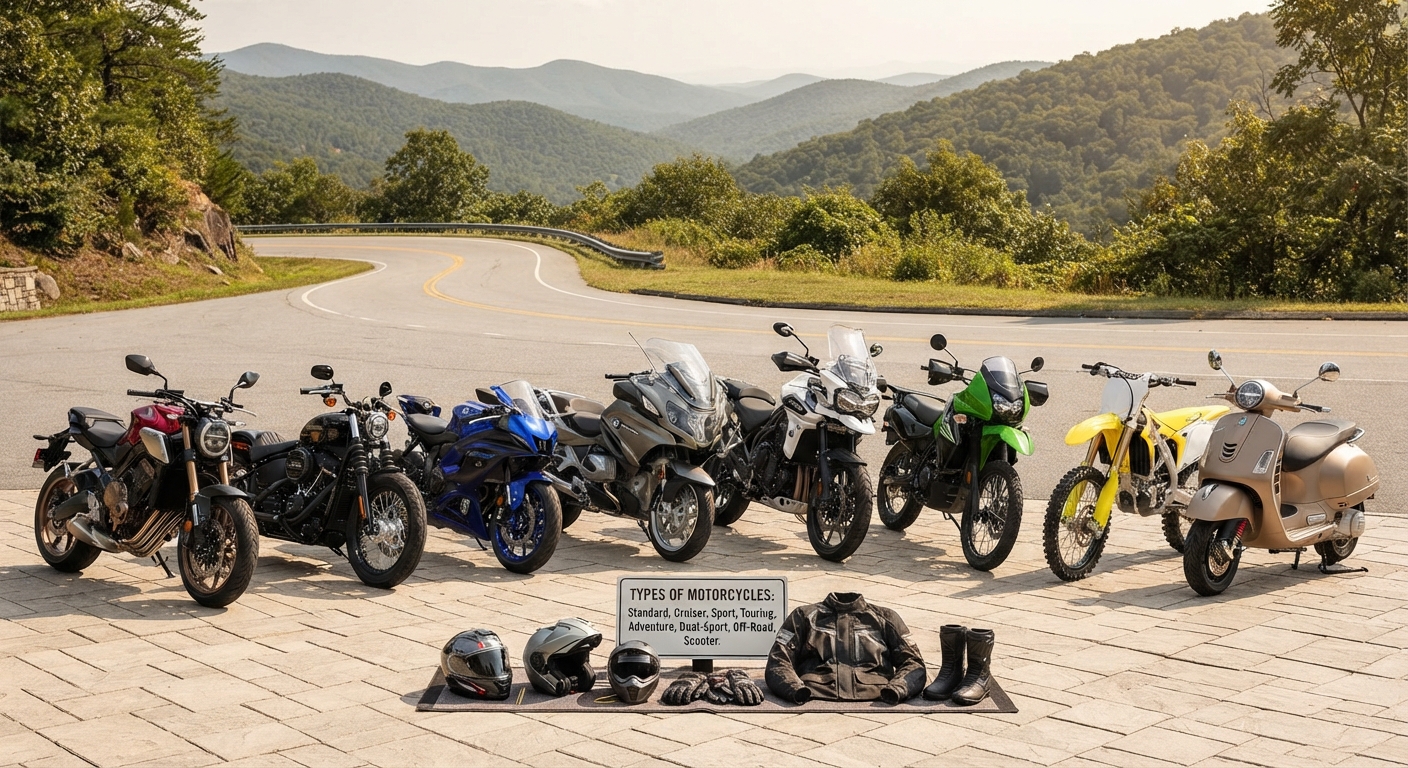
A motorcycle is a two-wheeled motor vehicle designed for transportation, recreation, competition, or touring. Unlike a car, a motorcycle relies heavily on rider balance, body position, throttle control, braking technique, and road awareness. Motorcycles range from lightweight commuter bikes and standard models to cruisers, sport bikes, adventure motorcycles, and touring machines. Choosing the right motorcycle depends on how and where you plan to ride, your experience level, physical fit, budget, and local licensing requirements. Understanding those factors before buying can make riding more practical, comfortable, and safer.
Quick Answer: A motorcycle is a powered two-wheeled vehicle. Major categories include standard, cruiser, sport, touring, adventure, dual-sport, scooter, and off-road motorcycles. The right choice depends on intended use, engine size, ergonomics, experience, running costs, and safety equipment.
What Is a Motorcycle?
A motorcycle is a motorized two- or three-wheeled vehicle generally designed to carry a rider and, depending on its configuration, a passenger.
Most conventional motorcycles have:
- Two wheels
- An engine or electric motor
- A frame
- Handlebars
- Rider-operated brakes
- A throttle
- Suspension
- A seat
- Headlights and other required road equipment
Motorcycles are fundamentally different from cars because the rider interacts directly with the machine’s balance and movement.
Acceleration, braking, cornering, wind, road surface, and body position all affect how the motorcycle behaves.
That direct connection is one reason motorcycles appeal to commuters, touring riders, enthusiasts, racers, and people who simply enjoy riding.
How Does a Motorcycle Work?
A conventional motorcycle converts energy from fuel into mechanical power through an internal-combustion engine.
In a simplified four-stroke engine, the cycle consists of:
- Intake — air and fuel enter the cylinder.
- Compression — the piston compresses the mixture.
- Power — combustion pushes the piston downward.
- Exhaust — spent gases leave the cylinder.
The engine turns a crankshaft, and that rotational power is transferred through the transmission and final drive to the rear wheel.
Electric motorcycles work differently. Instead of burning fuel inside cylinders, they use an electric motor powered by a battery pack.
Motorcycle transmission
Most traditional motorcycles use a manual sequential gearbox.
The rider typically changes gears with a foot-operated shift lever while controlling the clutch with the left hand.
Lower gears provide strong acceleration and are useful at lower speeds. Higher gears allow the engine to operate efficiently during faster cruising.
Automatic and continuously variable transmission systems are also available, particularly on scooters and some modern motorcycles.
Main Types of Motorcycles
There is no single motorcycle that suits every rider. Different categories are designed around different priorities.
1. Standard Motorcycle
Standard motorcycles are among the most versatile designs.
They generally provide an upright riding position, moderate ergonomics, and practical performance for everyday riding.
They can work well for:
- Commuting
- Short trips
- General road riding
- Learning basic motorcycle skills
- Weekend riding
Their relatively neutral design makes them a common starting point for riders who aren’t sure which specialized category they need.
2. Cruiser Motorcycle
Cruisers emphasize relaxed riding, low-speed comfort, styling, and a low seat height.
Many have:
- Low seats
- Relaxed steering geometry
- Large-displacement engines
- Comfortable highway-oriented ergonomics
- Strong low- and mid-range torque
Cruisers can be attractive for riders who prioritize relaxed road trips and distinctive styling.
However, a large cruiser can still be physically demanding because weight matters when maneuvering at low speeds or moving the motorcycle when the engine is off.
3. Sport Motorcycle
Sport motorcycles are designed around handling, acceleration, braking, and aerodynamic performance.
Typical features include:
- Forward-leaning ergonomics
- High-performance engines
- Strong braking systems
- Responsive suspension
- Lightweight or performance-oriented chassis
- Aggressive styling
A sport bike can be extremely capable, but capability does not automatically make it appropriate for a new rider.
For beginners, the motorcycle’s power, weight, ergonomics, and controllability matter more than its appearance.
4. Touring Motorcycle
Touring motorcycles are built for long-distance travel.
They commonly provide:
- Larger fuel capacity
- Wind protection
- Comfortable seating
- Luggage capacity
- Passenger accommodations
- Long-distance suspension and chassis tuning
A touring motorcycle can make hundreds of highway miles more manageable, although larger touring models can be heavy and expensive.
5. Adventure Motorcycle
Adventure motorcycles are designed to combine road touring with the ability to handle rougher surfaces.
Depending on the model, features may include:
- Long-travel suspension
- Large front wheels
- Upright ergonomics
- Protective equipment
- Luggage systems
- Larger fuel tanks
Some adventure motorcycles are heavily road-oriented, while others are designed for substantial off-road use.
6. Dual-Sport Motorcycle
A dual-sport motorcycle is designed for both paved roads and off-road riding.
Compared with a large adventure motorcycle, many dual-sport bikes are lighter and simpler.
They can be useful for riders who want to combine:
- Rural roads
- Trails where legally permitted
- Gravel roads
- Commuting
- Recreational off-road riding
Local regulations determine where a motorcycle can legally be operated.
7. Off-Road Motorcycle
Motocross and other off-road motorcycles are designed primarily for unpaved environments.
They often prioritize low weight, suspension travel, ground clearance, and maneuverability over highway equipment.
Many competition-focused off-road motorcycles are not street legal without appropriate equipment and approval.
8. Scooter
Scooters are often grouped separately from motorcycles because their design and transmission systems differ.
They commonly feature:
- Step-through frames
- Automatic transmissions
- Under-seat storage
- Smaller wheels
- Upright seating
Scooters can be particularly practical for urban transportation.
Motorcycle Engine Sizes
Engine displacement is commonly expressed in cc, or cubic centimeters.
For example, a motorcycle might have a 125cc, 300cc, 500cc, 650cc, or 1,000cc engine.
However, engine displacement alone does not determine performance.
Two motorcycles with similar displacement can feel very different because of differences in:
- Engine design
- Number of cylinders
- Weight
- Gear ratios
- Tuning
- Aerodynamics
- Torque delivery
- Electronics
A lightweight motorcycle with modest displacement can feel energetic, while a heavier motorcycle with a larger engine may emphasize relaxed torque and highway performance.
Does bigger always mean better?
No.
A larger engine can provide stronger acceleration and easier high-speed cruising, but it can also increase:
- Purchase price
- Fuel consumption
- Insurance costs
- Tire costs
- Weight
- Maintenance expenses
The better question is not “How big should the engine be?” but “What performance does my actual riding require?”
Choosing a Motorcycle for Beginners
A beginner motorcycle should be manageable rather than simply powerful.
Important factors include:
Seat height
You should be able to operate the motorcycle confidently at stops.
Seat height matters, but it isn’t the only consideration. Seat width, suspension sag, rider inseam, and riding position also affect how easily a rider can reach the ground.
Weight
A motorcycle that is difficult to control at low speed can become frustrating for a new rider.
Pay attention to the bike’s actual weight and how that weight is distributed.
Power delivery
Smooth, predictable throttle response is often easier for a new rider to learn than extremely aggressive power delivery.
Ergonomics
Sit on the motorcycle before buying.
Check:
- Handlebar reach
- Footpeg position
- Knee angle
- Seat comfort
- Mirror position
- Ability to operate controls
A motorcycle can have excellent specifications and still be uncomfortable for your body.
New vs. Used Motorcycle
Both new and used motorcycles have advantages.
| Factor | New Motorcycle | Used Motorcycle |
|---|---|---|
| Purchase price | Usually higher | Usually lower |
| Warranty | Often available | Depends on bike |
| Maintenance history | Starts with you | Must be verified |
| Depreciation | Usually greater initially | Often lower |
| Previous damage | Unlikely | Needs inspection |
| Technology | Latest equipment | Varies by year |
Buying used
If you’re considering a used motorcycle, inspect:
- Tires
- Brake pads and discs
- Chain and sprockets
- Fork seals
- Engine leaks
- Frame
- Controls
- Lights
- Battery
- Service records
- Vehicle identification number
Look closely for signs of accident damage.
A professional pre-purchase inspection can cost much less than repairing a poorly maintained motorcycle.
Motorcycle Maintenance Basics
Regular motorcycle maintenance affects reliability, safety, and operating costs.
The exact schedule depends on the motorcycle manufacturer, but common checks include:
Engine oil
Check the oil level and replace the oil according to the manufacturer’s service schedule.
Some motorcycles require specific oil grades, so the owner’s manual should be the reference.
Chain
For chain-driven motorcycles, inspect the chain for excessive slack, corrosion, damaged links, and poor lubrication.
Chain adjustment intervals vary by motorcycle and riding conditions.
Tires
Inspect tire pressure and tread regularly.
Correct pressure is important for handling, braking, tire life, and fuel economy.
Always use the manufacturer’s recommended cold tire pressures rather than relying on a generic number.
Brakes
Check brake fluid levels and inspect pads and discs.
Any change in braking feel, unusual noise, vibration, or visible damage deserves attention.
Battery
Modern motorcycles may have electronic systems that place demands on the battery even when the engine isn’t running.
If the motorcycle sits unused for extended periods, follow the manufacturer’s storage recommendations.
Motorcycle Safety Equipment
Protective equipment is an essential part of riding.
A basic gear setup can include:
- Certified motorcycle helmet
- Motorcycle jacket
- Gloves
- Riding pants
- Protective boots
- Eye protection when appropriate
- High-visibility equipment where useful
Helmet safety
A helmet is the most important piece of protective equipment.
Look for a helmet that fits correctly and meets the safety certification required in your jurisdiction.
A helmet should fit snugly without creating painful pressure points.
It should not move excessively when you shake your head.
Motorcycle Safety Skills
Good riding is about more than controlling the throttle.
Important skills include:
- Smooth braking
- Controlled acceleration
- Proper cornering
- Hazard recognition
- Lane positioning
- Emergency stopping
- Low-speed control
- Defensive riding
Formal rider training is one of the best ways for a new motorcyclist to develop these skills.
Training also teaches techniques that can be difficult to learn safely through trial and error.
Motorcycle Running Costs
The purchase price is only one part of the cost of motorcycle ownership.
A realistic budget may include:
Motorcycle + registration + insurance + fuel + maintenance + tires + protective equipment + repairs
Tires can be particularly significant because motorcycles use relatively small contact patches and tire condition directly affects handling.
A rider who plans frequent long-distance trips should also budget for luggage, routine servicing, and consumables.
Motorcycle Fuel Economy
Motorcycles can consume less fuel than many cars, but fuel economy varies widely.
Important factors include:
- Engine displacement
- Riding speed
- Aerodynamics
- Weight
- Riding style
- Traffic
- Maintenance condition
Aggressive acceleration and sustained high speeds generally increase fuel consumption.
Small commuter motorcycles often prioritize efficiency, while high-performance motorcycles sacrifice some economy for performance.
Electric Motorcycles
Electric motorcycles are becoming an increasingly visible part of the two-wheeled market.
Instead of an internal-combustion engine, they use a battery and electric motor.
Potential advantages include:
- Instant torque
- Quiet operation
- Reduced routine engine maintenance
- No engine oil changes
- Simple power delivery
Important considerations include:
- Purchase price
- Charging access
- Range
- Charging time
- Battery capacity
- Weight
- Long-term battery considerations
For urban commuters with predictable routes and convenient charging, an electric motorcycle can have a different ownership profile from a gasoline-powered bike.
Motorcycle Licensing and Legal Requirements
Licensing rules vary significantly by country and sometimes by region.
Requirements can involve:
- Minimum age
- Learner permits
- Written tests
- Practical riding tests
- Engine-size restrictions
- Motorcycle-specific endorsements
- Insurance
- Registration
- Helmet requirements
Because these laws change and differ between jurisdictions, riders should check the current requirements of their local transport authority.
Never assume that a car driving license automatically authorizes motorcycle operation.
Common Motorcycle Buying Mistakes
Buying too much motorcycle
A powerful motorcycle may look attractive, but excessive performance can make learning harder.
Ignoring ergonomics
A motorcycle that hurts your wrists, knees, hips, or back will become unpleasant quickly.
Forgetting ownership costs
Insurance, tires, servicing, fuel, and gear can substantially increase the real cost.
Skipping the inspection
Used motorcycles should be inspected carefully before purchase.
Choosing based only on appearance
A motorcycle should fit your actual riding environment.
A sport bike may look excellent, but a commuter who spends most of the week in congested traffic may prioritize completely different characteristics.
Frequently Asked Questions
What is a motorcycle?
A motorcycle is a powered two-wheeled vehicle designed for transportation, recreation, touring, competition, or other forms of riding. Most conventional motorcycles use an engine and manual transmission, although electric and automatic models are also available.
What are the main types of motorcycles?
Common categories include standard motorcycles, cruisers, sport bikes, touring motorcycles, adventure bikes, dual-sport motorcycles, off-road bikes, and scooters.
What motorcycle is best for a beginner?
There is no single best motorcycle for every beginner. A manageable combination of weight, power, seat height, predictable handling, comfortable ergonomics, and appropriate licensing requirements is generally more important than choosing a particular brand or model.
How often does a motorcycle need maintenance?
Maintenance intervals vary by model. Common service items include engine oil, chain adjustment and lubrication, tire checks, brake inspection, fluid checks, and manufacturer-specified scheduled services. Always use the owner’s manual for exact intervals.
Is a motorcycle cheaper to own than a car?
It can be, particularly for smaller motorcycles with good fuel economy and lower purchase prices. However, insurance, tires, protective gear, maintenance, registration, and repairs all contribute to total ownership cost.
Conclusion
A motorcycle is much more than a two-wheeled vehicle. It is a machine whose design can be optimized for commuting, touring, performance, adventure, recreation, or off-road riding. Understanding motorcycle categories, engine characteristics, ergonomics, maintenance, ownership costs, and safety equipment makes it easier to choose a bike that actually matches your needs.
For a first-time buyer, the most useful approach is to start with your real riding conditions rather than a particular motorcycle model. Consider your roads, experience, budget, passenger needs, storage requirements, and local licensing rules. Then compare motorcycles that fit those requirements.
