
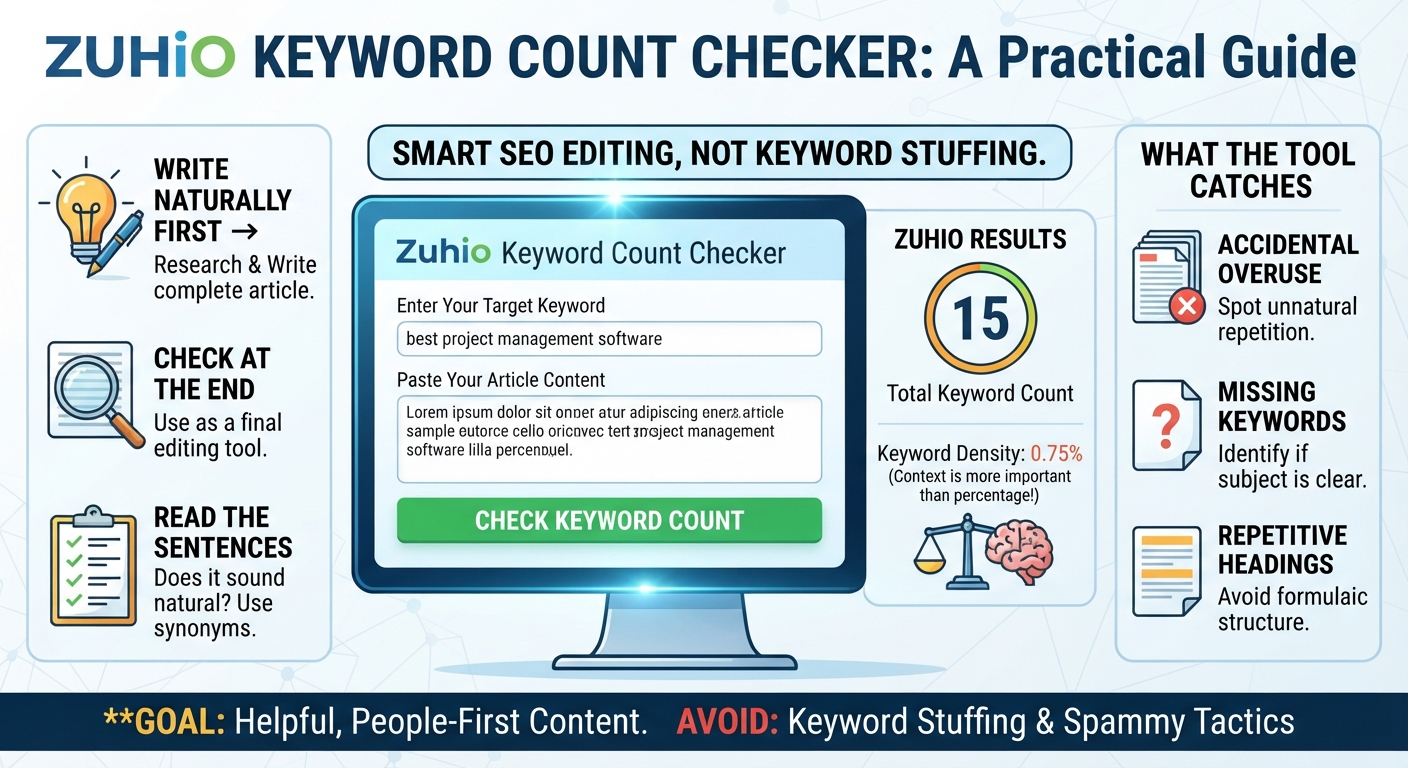
If you want to know how often a keyword appears in an article, the Zuhio keyword count checker is designed to make that check easier. It is presented as a browser-based utility for checking keyword usage in written content, helping writers see whether a target phrase appears enough—or starts becoming repetitive. Current online descriptions generally place its main purpose around keyword counting and frequency analysis, although some details about its interface and advanced features differ between sources.
The important part is knowing what the number actually means. A keyword counter can reveal repetition, but it cannot decide whether an article satisfies search intent, provides useful information, or deserves to rank.
Quick Answer: The Zuhio keyword count checker is a lightweight SEO/content utility intended to help writers check how frequently a target keyword or phrase appears in text. Use it as a final editing check—not as a rule telling you how many times a keyword must appear.
What Is the Zuhio Keyword Count Checker?
The Zuhio keyword count checker is an online tool associated with Zuhio that focuses on a simple content-analysis task: checking keyword usage within written text.
Several recent descriptions characterize it as a free browser-based checker where users provide content and a target keyword, then review the number of occurrences and, depending on the version or workflow being described, additional information such as keyword density or total word count.
That makes it different from a full SEO platform.
A tool such as this is not intended to replace keyword research, competitor analysis, rank tracking, backlink analysis, or technical SEO auditing. Instead, it addresses a much smaller question:
“How often did I actually use this keyword in my content?”
That can be useful immediately before publishing.
For example, imagine you have written a 1,800-word article targeting “best project management software.” You may remember using the phrase several times, but you may not know whether it appears five times, 15 times, or 40 times.
A keyword counter gives you an objective starting point.
Why Keyword Counting Still Has a Place in SEO
Keyword counting is sometimes misunderstood.
Modern SEO is not about repeating an exact phrase a predetermined number of times. Google has explicitly stated that it does not have an optimal keyword-density percentage. At the same time, Google recommends using the terminology people would actually search for and making the subject of a page clear.
That distinction matters.
You want search engines to understand what your page is about, but you also want the article to sound like something a human would willingly read.
Consider these two approaches.
Natural approach:
A good project management platform should make it easier to organize tasks, assign responsibilities, and monitor deadlines. The right choice depends on your team’s size and workflow.
Over-optimized approach:
The best project management software helps you find the best project management software because the best project management software is important when choosing the best project management software.
The second version may contain the target phrase repeatedly, but it is clearly worse for the reader.
Google’s spam policies specifically describe keyword stuffing as filling a page with keywords or numbers in an attempt to manipulate rankings, including repeating words or phrases so often that the result sounds unnatural.
So the useful role of a keyword count checker is quality control.
It helps you notice repetition that your brain may overlook while editing a long article.
How to Use the Zuhio Keyword Count Checker
The exact interface can change, and current third-party descriptions do not agree on every feature. One recent hands-on review describes two text areas—one for keywords and another for the article—while other sources describe a simpler target-keyword-and-content workflow.
For that reason, focus on the underlying workflow rather than assuming every interface element will look identical.
Step 1: Finish the Article First
Write your article naturally before worrying about the final keyword count.
This is one of the easiest ways to avoid awkward SEO writing. If you monitor the counter after every paragraph, you may start forcing the keyword into sentences where it does not belong.
Instead:
- Research the topic.
- Understand the search intent.
- Write the complete article.
- Edit for accuracy and readability.
- Check keyword usage at the end.
The counter should be part of your editing workflow, not your writing brain.
Step 2: Identify Your Target Keyword
Choose the primary phrase you are actually optimizing for.
For example:
Primary keyword: zuhio keyword count checker
You can separately consider related phrases such as:
- keyword frequency
- keyword density checker
- SEO content optimization
- keyword usage
- on-page SEO
- target keyword
This creates a more natural topical vocabulary than repeating one exact phrase throughout the article.
Step 3: Paste or Enter Your Content
Depending on the current version of the tool, you may be asked to paste the article and provide one or more keywords.
If you are checking a finished blog post, use the complete article rather than testing only the introduction.
That gives you a more useful picture of overall keyword frequency.
Step 4: Review the Keyword Count
The raw count tells you how many times the target term appears.
For example:
| Article length | Keyword occurrences | What to consider |
|---|---|---|
| 500 words | 2 | Probably normal |
| 1,000 words | 6 | Check context |
| 1,500 words | 10 | Review naturally |
| 2,000 words | 15 | Inspect for repetition |
| 2,000 words | 40 | Strong reason to edit |
These are illustrative examples, not Google rules.
There is no universal number of mentions that guarantees better rankings. Google has specifically said it does not use an “optimal keyword density” concept.
The point of the table is simply to demonstrate why context matters.
Step 5: Read the Sentences, Not Just the Number
This is the step that matters most.
Suppose your checker tells you that your target keyword appears 18 times.
Don’t immediately delete 10 occurrences.
Instead, search through the article and ask:
- Does each use sound natural?
- Is the phrase necessary in this sentence?
- Does it appear in headings where it genuinely describes the section?
- Are several occurrences clustered together?
- Could a synonym make the paragraph easier to read?
- Are you repeating the phrase simply because you want a higher count?
The number identifies a possible problem.
Your editorial judgment decides whether it actually is one.
Keyword Count vs. Keyword Density
These two concepts are related but not identical.
Keyword Count
Keyword count is the simple number of times a term or phrase occurs.
If your article contains the phrase 12 times, your keyword count is 12.
Keyword Density
Keyword density expresses keyword occurrences relative to the overall amount of content.
A simplified calculation is:
Keyword density = keyword occurrences ÷ total words × 100
For example, if a keyword appears 8 times in a 1,600-word article:
8 ÷ 1,600 × 100 = 0.5%
That number can provide context, but it should not become your SEO target.
Google’s guidance is particularly important here: there is no optimal keyword-density percentage. Being explicit about the topic is useful; mechanically hitting a percentage is not.
What the Zuhio Checker Can Help You Catch
A keyword counter is most useful when it reveals problems that are easy to miss during normal editing.
1. Accidental Overuse
You may mention your target keyword naturally in the introduction, several headings, examples, and conclusion.
Individually, each occurrence looks fine.
Together, they may make the article repetitive.
A count gives you a reason to review the pattern.
2. Missing Target Keywords
The opposite can also happen.
You may write a very comprehensive article but barely use the terminology associated with the search query.
If your target phrase never appears—or appears only once—you should check whether the page clearly communicates its subject.
This does not mean you should insert the phrase randomly.
Instead, consider natural locations such as:
- Title
- H1
- Introduction
- One relevant H2
- Image alt text where genuinely descriptive
- Conclusion
- Relevant body sections
Google’s Search Essentials recommend using words people would use to look for your content and placing relevant terminology in prominent, descriptive locations.
3. Repetitive Headings
Headings are particularly easy to over-optimize.
For example:
- Zuhio Keyword Count Checker Features
- Zuhio Keyword Count Checker Benefits
- Zuhio Keyword Count Checker Guide
- Zuhio Keyword Count Checker Results
- Zuhio Keyword Count Checker Tips
There is nothing inherently wrong with the phrase, but repeating it in every heading can make the page look formulaic.
A stronger structure could be:
- What the Tool Does
- How to Check Keyword Usage
- Understanding Your Results
- Common SEO Mistakes
- Better Ways to Optimize Content
The topic remains clear without making every heading identical.
Does a Higher Keyword Count Improve Rankings?
No.
There is no reliable SEO rule saying that a page will rank better because a target keyword appears 20, 30, or 50 times.
Google’s own guidance says it does not have an optimal keyword-density figure. Its current spam documentation also warns against excessive, unnatural repetition.
Think about keyword frequency as a diagnostic metric.
If the number is unexpectedly high, investigate.
If it is unexpectedly low, investigate.
But don’t optimize the article toward an arbitrary percentage simply because a tool displays one.
A useful SEO article should answer the user’s question comprehensively, use appropriate terminology naturally, and provide information that adds genuine value.
What the Tool Does Not Replace
The Zuhio keyword count checker can be useful, but it is only one small part of an SEO workflow.
It does not replace:
Keyword Research
You still need to understand what people search for and why.
A keyword counter cannot tell you whether a phrase has commercial intent, informational intent, or weak demand.
Search Intent Analysis
If someone searches “how to count keywords in an article,” they probably want instructions.
If someone searches “best keyword density tools,” they may want a comparison.
The same keyword can produce very different content requirements depending on intent.
Competitor Research
Counting your own keywords does not tell you what competing pages cover.
You still need to evaluate:
- Topic coverage
- Content depth
- User questions
- Original examples
- Internal links
- Page experience
- Trust signals
Technical SEO
A keyword counter cannot diagnose:
- Indexing problems
- Crawl issues
- Canonical errors
- Broken structured data
- Slow pages
- Mobile usability problems
Those require other tools and processes.
Zuhio Keyword Count Checker: Strengths and Limitations
Based on the current descriptions available online, the tool’s main attraction is its simplicity. Recent sources consistently describe it as a lightweight keyword-counting utility, while specific interface capabilities vary between reports.
| Area | Assessment |
|---|---|
| Simple keyword checking | Useful |
| Keyword frequency review | Useful |
| Beginner friendliness | Strong |
| Full keyword research | Not its purpose |
| Rank tracking | Not its purpose |
| Competitor analysis | Not its purpose |
| Complete SEO audit | Not its purpose |
| Content-quality evaluation | Requires human review |
Pros
- Simple concept
- Useful for final content checks
- Can expose excessive repetition
- Helps verify keyword usage
- More focused than a large SEO suite
Cons
- A count does not measure content quality
- Density can be easily misunderstood
- It does not replace keyword research
- Current third-party descriptions differ on some features
- Exact keyword frequency is not a Google ranking target
That last point is particularly important.
A tool can tell you what happened in your article. It cannot automatically tell you what should happen.
A Better SEO Workflow for Keyword Counting
If you regularly publish SEO articles, use a counter at the end of your workflow rather than letting it control your writing.
Before writing
Research:
- Primary search intent
- Related queries
- User questions
- Competing content
- Important subtopics
During writing
Focus on:
- Clear answers
- Useful examples
- Natural terminology
- Logical headings
- Short paragraphs
- Original insights
After writing
Then perform your optimization check:
- Check the target keyword.
- Review keyword frequency.
- Look for unnatural repetition.
- Replace unnecessary duplicates with natural language.
- Check headings.
- Verify internal links.
- Review title and meta description.
- Proofread the final article.
This sequence protects the quality of the writing.
It also aligns better with Google’s broader guidance to create helpful, reliable, people-first content rather than pages designed primarily to manipulate search rankings.
What About a 1%–2% Keyword Density Target?
You will find articles online recommending a specific density range, sometimes 1%–2%.
Treat those numbers cautiously.
They can be useful as a rough editorial reference, but they are not official Google requirements. Google’s own documentation explicitly says there is no optimal keyword density.
For example, forcing a keyword into a 2,000-word article simply to reach 2% would require around 40 occurrences.
That could be perfectly natural for some topics—but absurd for others.
The subject, language, article structure, and natural vocabulary all matter.
A better question is:
“Does the page clearly communicate its topic without sounding repetitive?”
That is a much more useful editorial standard.
How to Avoid Keyword Stuffing
If your counter shows a surprisingly high number, don’t panic.
Try these fixes:
- Remove unnecessary repetitions.
- Combine sentences that say the same thing.
- Use pronouns when the reference is obvious.
- Use natural synonyms where appropriate.
- Rewrite repetitive headings.
- Replace exact-match phrases with descriptive language.
- Read the article aloud.
- Ask whether a real reader would notice the repetition.
Google’s spam policies specifically identify unnatural repetition as keyword stuffing.
The goal is not to hide keywords.
The goal is to stop writing for the keyword counter instead of the reader.
Is the Zuhio Keyword Count Checker Worth Using?
For a writer who simply wants to inspect keyword frequency, a lightweight checker can be useful.
Its value comes from speed.
You don’t need a massive SEO dashboard every time you want to answer a basic editorial question. If your article is finished and you want to see whether you have accidentally repeated a phrase too often, a dedicated keyword counter can save time.
However, don’t treat the tool as an SEO scorecard.
A page can have a “perfect” keyword count and still fail because it:
- Doesn’t answer the searcher’s question
- Contains inaccurate information
- Offers nothing original
- Has poor structure
- Uses weak sources
- Provides a frustrating user experience
Conversely, an article can have a very low exact-match count and still communicate its topic extremely well.
That’s why the best approach is simple:
Use the number to find potential problems, then use human judgment to fix them.
Frequently Asked Questions
What is the Zuhio keyword count checker?
It is an online utility associated with Zuhio that is designed to help users check how frequently a keyword or phrase appears in written content. Current third-party descriptions commonly associate it with keyword frequency and, in some versions or workflows, density information.
How does the Zuhio keyword count checker work?
The general workflow is to provide your target keyword or keywords and the content you want to inspect. The tool then reports keyword usage so you can review whether the phrase is missing, appropriately used, or potentially repetitive. Specific interface features can vary between current descriptions.
Is keyword density still important for SEO?
Keyword density is not an official Google ranking target. Google has stated that it does not have an optimal keyword-density percentage. What matters more is making the page’s subject clear while producing useful, natural content for people.
Can too many keywords hurt SEO?
Yes, excessive and unnatural keyword repetition can become keyword stuffing. Google’s spam policies specifically identify repeated words or phrases that make content sound unnatural as an example of keyword stuffing.
Should I use a keyword counter before publishing?
It can be a useful final quality check. Use it to identify unexpected repetition or missing terminology, but don’t rewrite an otherwise good article solely to reach an arbitrary keyword-density percentage.
Conclusion
The zuhio keyword count checker addresses a small but practical part of content optimization: understanding how often a target keyword appears in a piece of writing. That can be valuable when you’re reviewing a long article and want an objective way to spot repetition.
But the number is not the goal.
Modern SEO is much broader than keyword frequency. Google recommends helpful, reliable, people-first content and explicitly warns against keyword stuffing and other attempts to manipulate search visibility.
Use a keyword counter as an editorial safety check, not as a ranking calculator. Write naturally first, analyze the finished draft second, and make changes only when they improve clarity or usefulness.
