
Introduction
Ensora Data Collection is a digital tool designed to help Applied Behavior Analysis (ABA) professionals record, organize, and analyze data about learner progress during therapy and educational sessions. The application supports structured data collection, progress tracking, visual reports, and documentation that can help teams evaluate whether an intervention is working. It is associated with Ensora Health and the platform formerly known as Catalyst. For therapists, behavior technicians, supervisors, and administrators, understanding how Ensora Data Collection works is important for both effective clinical documentation and responsible handling of sensitive information.
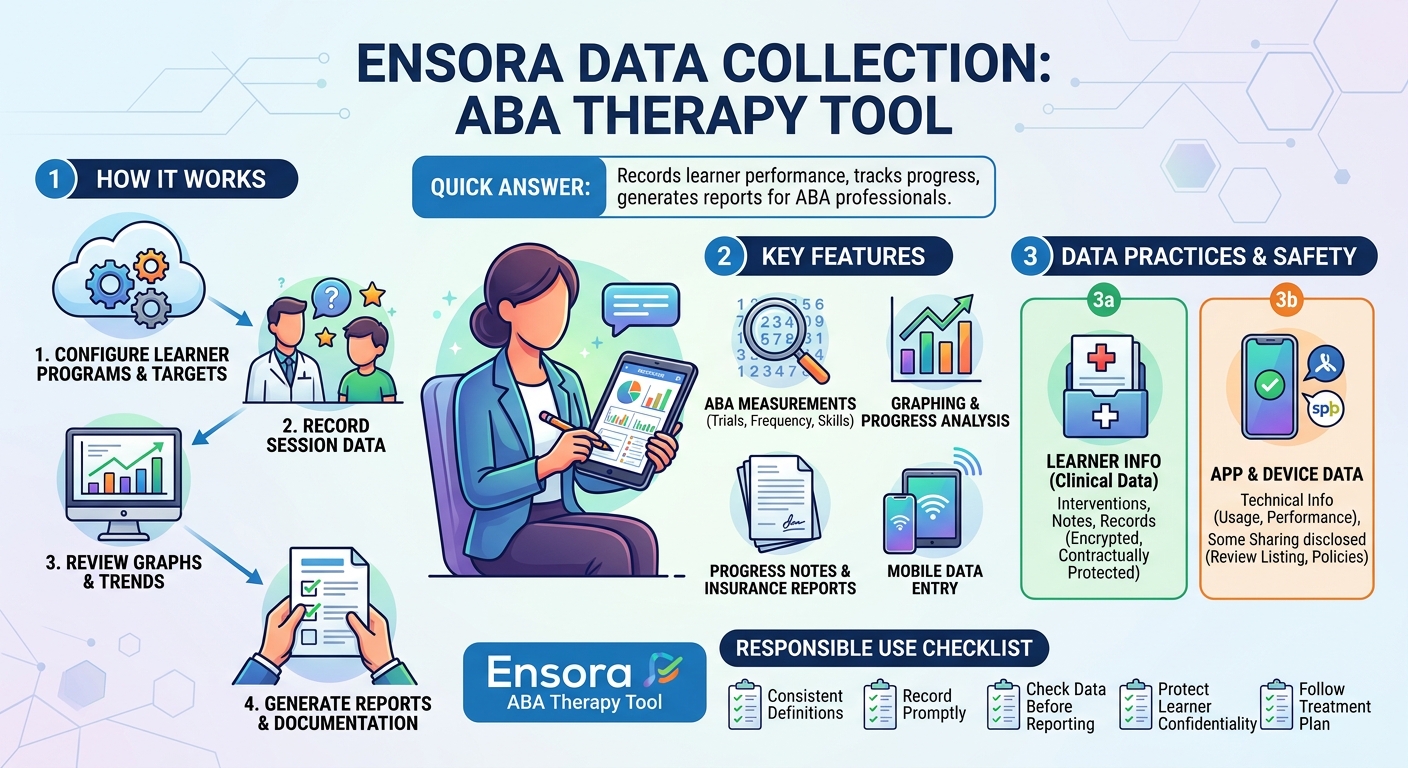
Quick Answer: Ensora Data Collection is an ABA data collection application used to record learner performance, monitor skill acquisition, track behavioral measurements, and generate graphs and reports. Its Google Play listing also discloses certain app data collection and sharing practices, which users should review before entering sensitive information.
What Is Ensora Data Collection?
Ensora Data Collection is a software application built for professionals who need to record structured information during ABA therapy and related educational programs.
Applied Behavior Analysis uses systematic observation and measurement to understand behavior and evaluate interventions. Instead of relying entirely on handwritten notes or memory, professionals can use a data collection application to record observations and review changes over time.
According to the product’s official app listing, users can collect information through discrete-trial data, task analysis, frequency counters, and skill-acquisition measurements. The platform also provides graphing and reporting tools that help teams review performance and prepare documentation.
The product is featured in the Ensora Experience knowledge hub, which includes training materials for ABA data collection, app workflows, administrative settings, student records, programs, targets, and reporting.
Official resources:
How Does Ensora Data Collection Work?
The application supports a workflow in which professionals record observations, organize measurements, and use the resulting information to evaluate learner progress.
1. Set Up Learner Programs and Targets
ABA programs commonly contain learning goals, skill areas, and specific targets. A target might involve following a direction, communicating a request, completing a task, or demonstrating another measurable skill.
Within an appropriately configured system, these targets provide a consistent structure for recording observations.
For example, a behavior technician working on a communication goal may record whether a learner independently requests an item or needs prompting. The exact measurement method depends on the treatment plan and the target being evaluated.
2. Record Session Data
During a session, the professional records relevant observations using the available data collection tools.
The official app listing describes several measurement options, including:
- Discrete-trial data
- Task-analysis measurements
- Frequency counting
- Skill-acquisition data
- Customizable data views
Different measurements answer different questions. Frequency counting records how often a behavior occurs, while task analysis can help document performance across the steps of a larger activity.
Accurate recording matters because errors can affect later interpretations of progress.
3. Review Graphs and Trends
After data has been collected, graphing tools help professionals examine patterns over time.
A supervisor might compare performance across several sessions, review the number of independent responses, or examine whether a learner is approaching a defined mastery criterion.
Graphs can make patterns easier to recognize, but they do not automatically establish why a change occurred. Professionals still need to consider context, measurement quality, intervention changes, and other relevant factors.
4. Generate Reports and Documentation
The product listing describes reporting tools that can combine data, graphs, and information for progress notes and insurance reports.
This can reduce the need to recreate the same information manually in multiple documents.
However, a generated report should always be reviewed for completeness and accuracy before it is used for clinical, administrative, or reimbursement purposes.
Key Features of Ensora Data Collection
Structured ABA Measurements
The application supports different ways to measure performance, helping professionals select a method appropriate to the target.
For example, a frequency counter may be useful when the goal involves counting observable occurrences, whereas task analysis can be appropriate for activities involving multiple steps.
The measurement method should follow the treatment plan rather than being selected simply because it is convenient in the software.
Skill-Acquisition Tracking
Skill acquisition involves measuring how a learner develops a particular ability over time.
Recording performance consistently allows a team to examine whether a learner is responding independently, requires prompting, or demonstrates changing levels of accuracy.
This information can support clinical decisions when interpreted by qualified professionals.
Graphs and Progress Analysis
Visual reporting helps teams compare measurements across sessions, instructors, and time periods.
The official product listing describes customizable graphing and reporting capabilities, including views related to trial counts and progress toward mastery criteria.
These tools are most useful when the underlying data is recorded consistently and the selected graph matches the question being investigated.
Progress Notes and Insurance Reports
Clinical documentation often requires information collected during therapy sessions to be summarized in a clear, organized format.
Ensora Data Collection advertises reporting capabilities that can help combine collected measurements and graphs into documentation.
Automation can save time, but it does not remove the need for professional review. Reports should accurately reflect what occurred during the session and comply with the organization’s documentation requirements.
Mobile Data Entry
The app is listed for mobile devices, making it possible for authorized users to record information through supported devices.
Mobile access can be practical in settings where observations happen during activities rather than at a desk. Staff should nevertheless follow organizational rules for device security, account access, and handling sensitive learner information.
What Data Does Ensora Data Collection Collect?
The phrase “Ensora data collection” can refer to two different things: the learner information recorded through the app and the technical information the application may collect about device use.
These categories should not be confused.
Learner and Session Information
Depending on the organization’s configuration and the features used, an ABA data collection system may contain information such as:
- Learner identifiers and records
- Program and skill targets
- Session measurements
- Behavioral observations
- Progress notes
- Graphs and reports
- Information entered by authorized professionals
These examples describe the kinds of information used in ABA documentation; they are not a complete, independently verified inventory of every field stored by Ensora.
Because learner records may contain sensitive information, organizations should confirm which fields are collected, who can access them, and how long they are retained.
Device and App Information
The Google Play listing identifies several categories that the developer says the application may collect or share.
Its current disclosure indicates that the app may collect photos and videos, audio, and other data categories. It also indicates that certain types of app activity, app information and performance data, and device or other identifiers may be shared with third parties.
The listing states that data is encrypted in transit. It also currently indicates that data cannot be deleted through the app’s disclosed data-safety arrangement.
These are developer-provided disclosures displayed by Google Play, not an independent audit of the app’s implementation. Users should review the current listing and applicable privacy policy because disclosures may change.
Is Ensora Data Collection Safe?
Security should be evaluated through several factors rather than a single claim.
Ensora Health publishes compliance and privacy information, including documentation about its security practices and handling of protected health information. Its policies describe access controls, privacy safeguards, and contractual protections relevant to its healthcare services.
However, a company’s general security commitments do not establish that every product configuration, user account, device, or workflow is risk-free.
Before using Ensora Data Collection, organizations should consider the following questions:
- Are individual user accounts assigned to authorized staff?
- Are access permissions appropriate to each person’s role?
- Are devices protected with strong authentication?
- Are staff trained to avoid unauthorized disclosure?
- Are records transmitted and stored under appropriate safeguards?
- Are privacy policies and contractual requirements current?
- Is there a documented process for handling suspected security incidents?
The answers should be confirmed with the organization’s administrator and the vendor’s current documentation.
Does Ensora Share or Sell Data?
The answer depends on which data and which Ensora service you mean.
The Google Play disclosure for Ensora Data Collection says certain app data categories may be shared with third parties. The listing also provides information about data collection, encryption in transit, and deletion.
Separately, Ensora Health’s compliance materials describe how the company handles protected health information in its healthcare software services. Its Responsible and Ethical AI Policy says client protected health information is not used to train AI models and that such information is not sold or shared with third parties except as necessary to provide services.
These statements should not be treated as interchangeable. The broader Ensora Health policy may cover particular services and contractual relationships, while the app-store disclosure describes the mobile application’s declared data practices.
To understand the rules that apply to your situation, consult the current product-specific privacy policy and any applicable service agreement.
Relevant sources:
- Ensora Data Collection app listing
- Ensora Health privacy and compliance information
- Ensora Health Responsible and Ethical AI Policy
How to Use Ensora Data Collection Responsibly
Good data practices are just as important as the software itself.
Use Consistent Measurement Definitions
Before collecting information, staff should understand the operational definition of each target and the method used to measure it.
For example, two staff members should not count the same behavior differently because they interpret the target in different ways.
Consistent definitions improve the usefulness of comparisons across sessions.
Record Information Promptly
Recording observations as close to the time they occur can reduce reliance on memory.
Staff should follow the organization’s workflow for documenting missed observations, corrections, and unusual session circumstances rather than filling gaps with guesses.
Check Data Before Reporting
Review measurements for missing entries, unexpected values, and inconsistencies before generating reports.
If several sessions appear to show an abrupt change, verify the data and consider whether a change in procedure or recording method might explain it.
Protect Learner Confidentiality
Use only authorized accounts and approved devices. Avoid placing identifiable learner information in personal notes, unapproved applications, or public communications.
When sharing reports, confirm that the recipient is authorized to receive the information and that the sharing method meets organizational requirements.
Follow the Treatment Plan
Software can organize and display measurements, but it does not replace clinical judgment.
Changes to treatment goals or interventions should be made by the appropriately qualified professional, using the learner’s needs, collected evidence, and applicable professional standards.
Ensora Data Collection vs. Manual Tracking
| Factor | Ensora Data Collection | Manual Tracking |
|---|---|---|
| Data entry | Digital | Paper or separate documents |
| Progress review | Graphs and reporting tools | Often requires manual calculations |
| Report preparation | Can automate parts of reporting | Often more time-consuming |
| Data consistency | Depends on setup and staff training | Depends on forms and recording habits |
| Access management | Requires account and device controls | Requires physical or digital document controls |
| Privacy risks | Digital access and transmission risks | Physical loss, unauthorized viewing, or misfiling |
| Best use | Structured digital ABA workflows | Settings where manual tools are appropriate |
Neither approach guarantees accurate records. The quality of the information depends on clear definitions, reliable observations, suitable procedures, and proper review.
Common Challenges and Practical Solutions
Inconsistent Data Entry
When staff interpret targets differently, recorded measurements may become difficult to compare.
Solution: Provide written definitions, staff training, and periodic checks of measurement consistency.
Missing or Delayed Records
Busy sessions can make documentation difficult.
Solution: Establish a clear workflow for recording observations and addressing missing data without inventing values.
Difficulty Interpreting Graphs
A graph may show that performance changed without explaining why.
Solution: Review the underlying observations and session context before drawing conclusions or changing an intervention.
Privacy and Access Concerns
Sensitive records can be exposed through shared accounts or poorly secured devices.
Solution: Use individual accounts, appropriate access permissions, approved devices, and documented security procedures.
Technical Problems
Login difficulties, synchronization problems, or slow loading can interrupt documentation.
Solution: Follow the official support process, keep the app updated, and use an approved contingency procedure when digital recording is unavailable.
Frequently Asked Questions
What is Ensora Data Collection used for?
Ensora Data Collection is an ABA-focused application used to record learner performance, track skill acquisition, analyze measurements, and prepare progress-related reports.
Is Ensora Data Collection the same as website analytics?
No. The product discussed here is an ABA data collection application. Although its mobile app may also collect technical information about device use and app performance, its main purpose is to support structured ABA data collection.
What information does Ensora Data Collection collect?
The information may include learner and session records entered through the platform, along with certain technical data categories disclosed in the app-store listing. The exact information depends on the features used, organizational configuration, and current privacy documentation.
Can data collected through Ensora be deleted?
The Google Play listing currently indicates that data cannot be deleted under the app’s disclosed data-safety information. This does not by itself resolve every possible account, record-retention, or legal deletion request. Ask the organization’s administrator and Ensora support about the applicable process.
Where can users find Ensora Data Collection training?
The Ensora Experience Data Collection knowledge hub provides documentation on app workflows, student records, programs, targets, reporting, and other platform features.
Conclusion
Ensora Data Collection provides digital tools for recording ABA session data, monitoring learner progress, creating graphs, and supporting clinical documentation. Its value depends on consistent measurement, accurate records, appropriate professional interpretation, and responsible handling of sensitive information.
Privacy deserves equal attention. Users should distinguish learner records from technical app data, review the current app-store disclosures, and consult the applicable Ensora policies before deciding how information should be collected, shared, or retained.
