
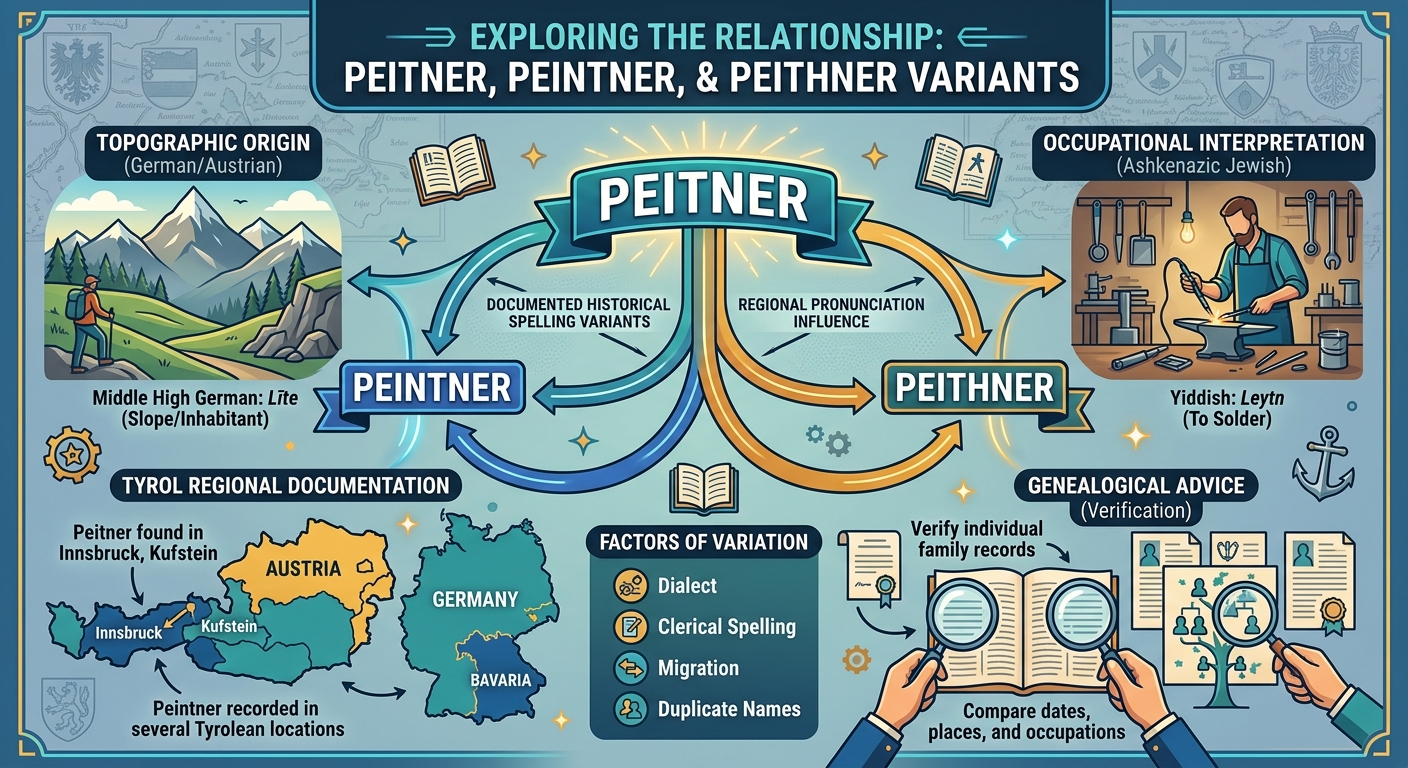
If you have come across the surname Peitner, it is most likely a family name with roots in Central European naming traditions. FamilySearch identifies two documented explanations: a German/Austrian topographic origin connected with a mountain slope or spur, and a separate Ashkenazic Jewish occupational origin associated with soldering.
That does not mean every person named Peitner comes from the same family. Like many older European surnames, its history can involve different regions, languages, spellings, migrations, and unrelated family branches.
Quick Answer: What Is Peitner?
Peitner is a relatively uncommon surname associated with German-speaking Central Europe, particularly Austria and Bavaria. Historical surname references give more than one possible origin, so there is no single meaning that can automatically be applied to every Peitner family.
The name also appears in historical Austrian and Tyrolean records. The Tyrol regional archive’s surname index, for example, lists Peitner in Innsbruck and Kufstein, alongside related forms such as Peintner and Peithner.
For genealogy research, the most important lesson is simple: treat Peitner as a starting point, not as proof of a particular ancestry.
What Does the Peitner Surname Mean?
The meaning of Peitner is more complicated than a simple dictionary definition.
FamilySearch, citing the Dictionary of American Family Names, gives two principal explanations. The first describes Peitner as a German or Austrian topographic surname for someone associated with a mountain slope or spur. The second is an Ashkenazic Jewish occupational explanation connected with the Yiddish word leytn, meaning “to solder.”
This distinction matters because surnames can develop independently in different communities.
1. A German and Austrian Topographic Origin
The German/Austrian interpretation connects the name with landscape.
According to FamilySearch, the explanation derives from Middle High German līte, referring to a mountain slope or spur, combined with a suffix indicating an inhabitant. In this interpretation, the original surname may have identified someone who lived near a particular type of elevated or sloping terrain.
Topographic surnames were practical identifiers in communities where people were commonly distinguished by where they lived.
A person’s name might eventually reflect a hill, valley, stream, settlement, occupation, or other recognizable feature. As these descriptions became hereditary, they could survive long after the family moved away from the original location.
2. A Separate Occupational Interpretation
FamilySearch also records an Ashkenazic Jewish interpretation connecting Peitner with Yiddish leytn, meaning “to solder,” plus an agent suffix. This suggests an occupational connection with soldering or metalworking.
This should not be presented as proof that a particular Peitner ancestor worked as a metalworker.
Instead, it is one documented explanation for the surname. Genealogical evidence from an individual’s family records is needed before connecting that explanation to a specific family branch.
Is Peitner a German Surname?
Peitner has documented German-language and Austrian associations, but describing every Peitner family simply as “German” would be too broad.
FamilySearch specifically associates the German interpretation with Bavaria and Austria. Historical Central Europe also experienced changing borders, migration, and administrative systems, meaning an ancestor’s historical location may not correspond neatly with today’s country boundaries.
This is especially relevant when researching families from the Alpine regions.
For example, the Tyrol government’s surname index lists Peitner in Innsbruck and Kufstein, while also recording Peintner in several Tyrolean locations and Peithner in Innsbruck.
So rather than asking only, “Was my ancestor German?” a genealogy researcher should ask:
- What town did the ancestor live in?
- Which parish recorded the family?
- What language was used in the document?
- Which country or territory governed the location at that time?
- What spelling appears in the original record?
- Do birth, marriage, and death records connect the individual to the same family?
Those questions produce much stronger evidence than surname meaning alone.
Peitner, Peintner, and Peithner: Are They Related?
One of the most useful areas to investigate is the relationship between Peitner, Peintner, and Peithner.
The names are similar enough that researchers may encounter different spellings for what appears to be the same family. The Tyrol government surname index independently lists all three forms in its regional surname material.
However, similar spelling does not automatically establish a family relationship.
Historical records were not always standardized. A surname could be written differently because of:
- Regional pronunciation
- Local dialect
- Different languages
- Handwriting interpretation
- Clerical spelling
- Changes in administration
- Migration
- Later transcription into digital databases
The Austrian State Archives also contains historical records involving Peithner and references to the Peintner family, demonstrating that these forms occur in genuine historical archival material.
For genealogy purposes, it is therefore sensible to search all three spellings.
A Practical Variant-Search Strategy
When researching an ancestor named Peitner, search:
- Peitner
- Peintner
- Peithner
Then compare the results using dates, places, parents, spouses, occupations, and other identifying information.
A matching surname by itself is weak evidence. A matching surname plus the same village, approximate birth date, parents, spouse, and occupation is considerably more useful.
Where Is the Peitner Name Found?
Modern genealogy databases show that Peitner is uncommon but appears in historical records from several countries.
FamilySearch currently reports more than 20,000 historical records associated with the Peitner last name, while its surname page identifies Hungary, Germany, and Croatia among locations where the name appears in its Family Tree data.
These database figures should be interpreted carefully.
A record count is not the same thing as the number of living people with the surname. It can include multiple records for the same person, historical documents, family-tree entries, and records from different periods.
Austria and Tyrol
Austria is particularly important when investigating Peitner genealogy because the surname is documented in Tyrolean regional material.
The Tyrol government’s surname index lists Peitner in Innsbruck and Kufstein, while related forms occur in several additional Tyrolean communities.
This makes Austrian parish registers, civil records, local archives, and historical directories potentially valuable research sources.
Bavaria
Bavaria is another important geographic association because the German/Austrian surname explanation specifically identifies Bavaria and Austria.
If your Peitner ancestor was associated with Bavaria, do not immediately assume that the family remained there for generations. Migration between neighboring Central European regions was common, and historical records may place one generation in Bavaria and another in Austria or elsewhere.
Other Countries
Genealogical databases also contain Peitner records outside the German-speaking Alpine region.
FamilySearch’s historical-record search includes examples from Germany and the United States, including birth, baptism, tax, and other records.
This makes migration records particularly useful for researchers trying to connect European Peitner ancestors with later generations overseas.
How to Research Peitner Family History
If Peitner genealogy is your goal, start with the most recent confirmed ancestor and work backward.
Step 1: Start With Your Own Family Records
Collect everything already available:
- Birth certificates
- Marriage certificates
- Death certificates
- Obituaries
- Family Bibles
- Immigration papers
- Old photographs
- Letters
- Naturalization documents
- Cemetery information
Write down the exact spelling shown in each document.
Step 2: Record Places, Not Just Names
A place can be more useful than a surname.
Instead of writing only:
Johann Peitner
record as much as possible:
Johann Peitner — born approximately 1880 — Austria — married Maria — lived in [specific town]
This makes it easier to distinguish two unrelated people with the same surname.
Step 3: Search Spelling Variants
Use Peitner, Peintner, and Peithner when searching historical databases.
Do not assume the database spelling is identical to the spelling used by your ancestor. Original documents should be checked whenever possible.
Step 4: Check Historical Records
FamilySearch provides access to categories including birth and baptism records, census material, immigration records, and other historical collections. Its Peitner search currently shows tens of thousands of historical records.
Ancestry also provides Peitner family-history records, including birth, marriage, death, military, immigration, census, and voter records.
Step 5: Move From Databases to Archives
Online genealogy databases are excellent discovery tools, but they should not be the final word.
Once you identify a likely town or parish, investigate the relevant regional archive.
For an Austrian or Tyrolean branch, government and archival collections can provide valuable historical context that may not appear in commercial genealogy databases. The Tyrol government, for example, maintains a regional surname index that includes Peitner and related names.
Does the Peitner Name Prove Noble Ancestry?
No.
This is an important point because historical records can contain individuals with related surnames who received titles, coats of arms, or official recognition.
The Austrian State Archives contains records concerning Peithner family members and historical noble-status documentation.
But the existence of a documented noble or heraldic Peithner/Peintner line does not prove that every person named Peitner descends from that family.
Genealogy requires a documented chain connecting one generation to the next.
A coat of arms associated with a particular historical family should therefore not automatically be presented as the coat of arms of everyone who shares a similar surname.
What Makes Peitner Genealogy Difficult?
Rare surnames can actually create several research challenges.
Spelling Variation
A family may appear under Peitner in one document and Peintner or Peithner in another.
Changing Borders
A historical town can belong to a different country today than it did when an ancestor lived there.
Duplicate Names
Several unrelated people may have identical first and last names.
Incomplete Records
Older records may have been damaged, lost, moved, or never digitized.
Database Transcription
A handwritten surname can be incorrectly transcribed during digitization.
For these reasons, the strongest genealogy research combines several independent records instead of relying on one search result.
Peitner at a Glance
| Detail | What the evidence shows |
|---|---|
| Name type | Surname |
| Main historical association | Central Europe |
| German/Austrian association | Bavaria and Austria |
| Alternative documented interpretation | Ashkenazic Jewish occupational origin |
| Possible topographic meaning | Mountain slope or spur |
| Occupational interpretation | Soldering/metalworking |
| Related spellings | Peintner and Peithner |
| Useful research areas | Austria, Bavaria, Tyrol and migration records |
| Best genealogy approach | Verify individuals through original records |
The surname information and etymological explanations in this table are based primarily on FamilySearch’s surname reference, while the Tyrolean geographic evidence comes from the regional government surname index.
Frequently Asked Questions About Peitner
What does the surname Peitner mean?
Peitner has more than one documented possible origin. FamilySearch describes a German/Austrian topographic interpretation associated with a mountain slope or spur and a separate Ashkenazic Jewish occupational interpretation connected with soldering.
Is Peitner a German name?
It has documented German-language associations, particularly with Bavaria and Austria. However, surname origin alone cannot establish the nationality or exact ancestry of an individual Peitner family.
Are Peitner, Peintner, and Peithner the same surname?
They can occur as related historical spelling forms, and Tyrolean and Austrian records document all three names. However, researchers should verify relationships using individual family records rather than assuming that every bearer belongs to one family.
Where can I research Peitner ancestry?
Start with family documents and genealogy databases such as FamilySearch and Ancestry, then move to local parish, civil, and regional archival records for the specific town or region associated with your ancestor.
Does the Peitner surname prove a specific ethnic or religious background?
No. The documented surname explanations include more than one historical tradition. A surname can suggest research directions, but it cannot by itself prove a person’s ethnicity, religion, nationality, or exact family lineage.
Conclusion: Understanding the Peitner Name
Peitner is best understood as an uncommon surname with documented Central European roots and more than one possible historical explanation. The German/Austrian interpretation connects the name with a mountain slope or spur, while a separate Ashkenazic Jewish interpretation associates it with soldering as an occupation.
The surname also has an interesting relationship with Peintner and Peithner, which appear in historical Tyrolean and Austrian records.
For anyone researching a Peitner family tree, the best approach is to go beyond the surname itself. Search spelling variants, identify exact locations, compare dates and relatives, and verify online discoveries against original historical documents.
If Peitner is part of your family history, start with the oldest confirmed ancestor you know and build the family line backward one documented generation at a time.
