
Introduction
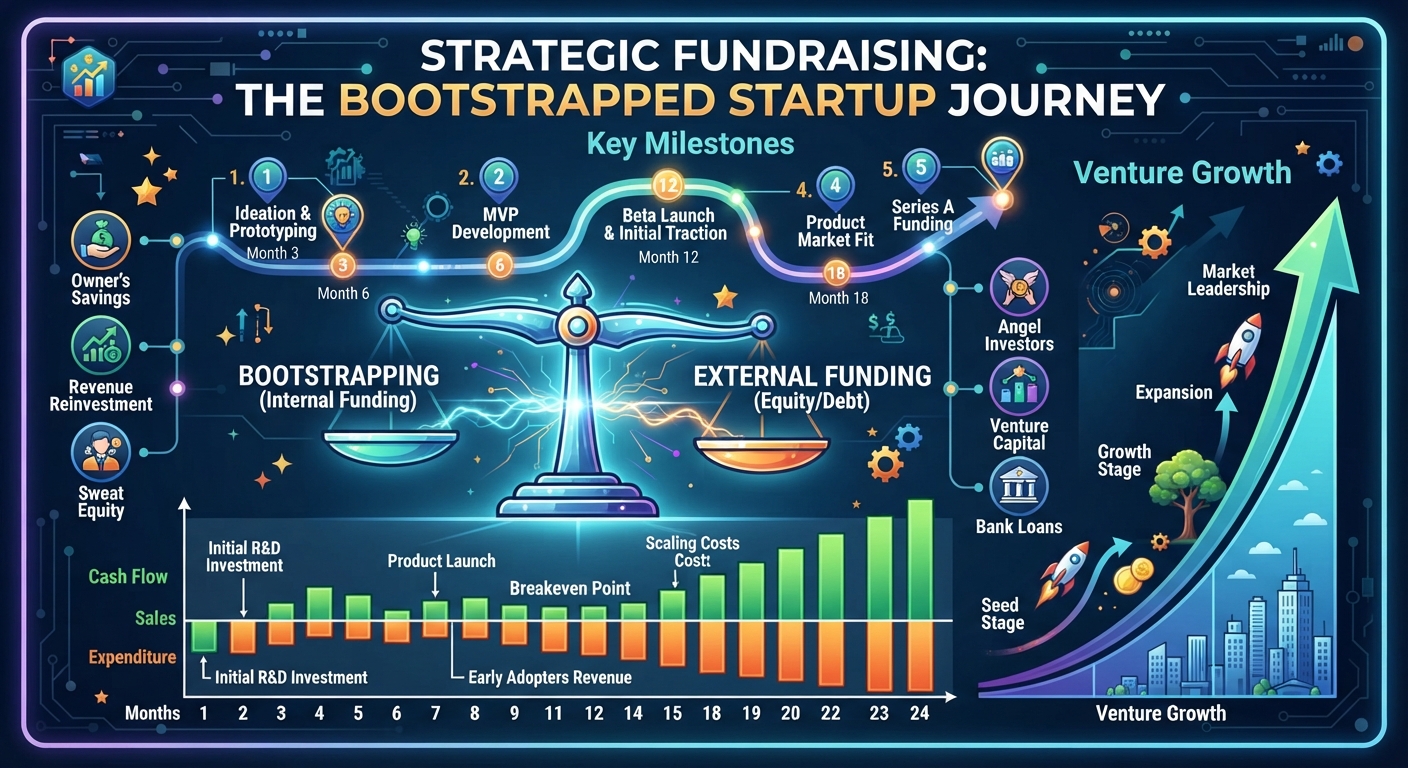
A successful startup booted fundraising strategy combines the discipline of bootstrapping with carefully selected funding opportunities. Instead of raising a large investment immediately, founders can validate demand, generate revenue, control expenses, and seek outside capital only when it supports a clear growth milestone. This approach helps entrepreneurs preserve ownership while building a stronger case for investors. Whether you are launching a software company, an online store, or a service business, the goal is to find the right balance between self-funded growth and external financing.
Quick Answer: A startup booted fundraising strategy means building a business with personal resources and customer revenue while selectively using funding options such as grants, crowdfunding, business loans, angel investment, or revenue-based financing. Start by validating demand, tracking cash flow, setting a funding target, and choosing capital that fits your growth plan.
What Is a Startup Booted Fundraising Strategy?
A startup booted fundraising strategy is a funding plan that prioritizes financial independence while keeping outside capital available when needed. It combines two approaches: bootstrapping, where founders rely on their own resources and business income, and fundraising, where they obtain money from external sources.
These approaches are not mutually exclusive. A founder might use personal savings to create a minimum viable product, earn revenue from early customers, and later raise a small investment to expand into a new market.
The important distinction is that funding should solve a specific business problem. Raising money simply because other startups are doing it can lead to unnecessary dilution, higher expenses, or pressure to grow before the business is ready.
Bootstrapping vs. Fundraising
| Factor | Bootstrapping | External fundraising |
|---|---|---|
| Main source | Savings and business revenue | Investors, lenders, grants, or crowdfunding |
| Ownership | Usually remains with founders | May be diluted when selling equity |
| Financial risk | Founders carry more direct financial risk | Risk is shared differently depending on the funding type |
| Growth pace | Often tied to available cash and revenue | May accelerate growth if capital is used effectively |
| Decision-making | Founders generally retain greater control | Investors or lenders may impose conditions |
| Best suited for | Businesses that can grow efficiently | Businesses needing capital to reach major milestones |
Neither model is automatically better. A profitable consulting company may grow comfortably through customer revenue, while a technology startup developing an expensive product may need outside investment to compete.
Why Founders Combine Bootstrapping and Fundraising
The hybrid approach gives founders time to understand their market before committing to a financing structure.
1. It helps preserve ownership
Equity fundraising means exchanging part of a company for investment. Founders who establish early revenue and demonstrate customer demand may be in a stronger position to negotiate with investors.
However, preserving ownership should not become the only objective. If additional capital could help a business capture a valuable opportunity, refusing all investment may slow growth unnecessarily.
2. It encourages spending discipline
When money comes from customer revenue, every major expense deserves scrutiny. Founders learn to distinguish between spending that produces measurable value and spending that merely makes the company look bigger.
For example, a small software company might use a simple landing page and direct customer outreach to validate demand before paying for a large marketing campaign.
3. It creates evidence for future investors
Investors often want to understand customer demand, product adoption, market potential, and the team’s ability to execute. Early revenue, repeat purchases, retention, and customer testimonials can help demonstrate progress.
There is no universal traction threshold that guarantees investment. The evidence investors expect depends on the industry, business model, company stage, and size of the opportunity.
7 Startup Booted Fundraising Strategies That Work
1. Start With a Minimum Viable Product
Build the smallest useful version of your product that can test the central business assumption. Avoid investing heavily in features customers have not requested or demonstrated a willingness to pay for.
A software founder, for example, could begin with a basic subscription tool that solves one specific problem. A service business could initially deliver its service manually before investing in automation.
Practical actions:
- Identify the main problem your product solves.
- Interview potential customers before building extensively.
- Test a basic offer with a small group of users.
- Track conversions, feedback, and repeat usage.
- Improve the product based on actual customer behavior.
The objective is not to create an unfinished product indefinitely. It is to reduce the amount of money spent before confirming that a real market exists.
2. Use Customer Revenue as Your First Funding Source
Revenue is often the most sustainable source of startup capital because it comes from customers receiving value. Depending on the business model, founders can use deposits, prepaid packages, subscriptions, or annual contracts to improve cash flow.
For example, a business software company might offer a discounted annual plan to customers who already understand the product’s value. The upfront payment can help cover operating expenses, provided the company can deliver the promised service.
Be careful with prepayments: they create future obligations. Keep enough cash available to provide the product, support customers, and issue refunds where required.
Best practice: Track monthly recurring revenue, customer acquisition cost, gross margin, churn, and cash collected. Revenue growth alone does not prove that the business is financially healthy.
3. Keep a Clear Cash Flow Plan
Cash flow determines whether a startup can pay its bills on time. A company can report sales and still face financial trouble if customers pay late while salaries, software subscriptions, and suppliers require immediate payment.
Create a rolling cash flow forecast covering at least the next 13 weeks. Update it regularly as customer payments and expenses change.
Include:
- Cash available today
- Expected customer payments
- Payroll and contractor costs
- Software, inventory, rent, and supplier expenses
- Tax obligations and debt repayments
- A reserve for unexpected costs
Example: Imagine a startup has $24,000 in available cash and expects to spend $6,000 each month after accounting for revenue. Its simple cash runway is four months.
The calculation is:
Cash runway = Available cash ÷ Monthly net cash burn
In this example, $24,000 ÷ $6,000 = 4 months. Actual runway will change if revenue, spending, or payment timing changes.
4. Explore Non-Dilutive Startup Funding
Non-dilutive funding provides capital without requiring founders to sell company equity. It can be attractive to businesses that want to preserve ownership, although some options create repayment obligations or impose eligibility conditions.
Potential sources include:
- Grants: Suitable programs may support research, innovation, exports, or regional economic development.
- Business loans: Provide capital that generally must be repaid with interest.
- Customer prepayments: Bring cash forward in exchange for future delivery.
- Reward-based crowdfunding: Supporters contribute in exchange for products, perks, or rewards.
- Accelerator programs: Some provide funding, mentorship, or investor access in exchange for equity or other agreed terms.
Grant availability varies by country, sector, and program. Treat grants as a potential funding source rather than guaranteed income, and never base essential operating expenses on an award that has not been approved.
5. Consider Revenue-Based Financing Carefully
Revenue-based financing generally provides capital in exchange for repayments linked to a percentage of future revenue until a specified repayment amount or contractual limit is reached.
This can suit businesses with relatively predictable revenue and healthy margins. However, repayment arrangements vary, and financing can become expensive if fees or repayment caps are high.
Before signing an agreement, calculate:
- The total amount you must repay
- The percentage of revenue deducted
- Any minimum payment or fixed repayment requirement
- Fees, default provisions, and personal guarantees
- How repayments affect cash available for growth
Compare the effective cost with other options. Do not assume revenue-based financing is cheaper or safer than equity simply because it does not immediately dilute ownership.
6. Build Relationships With Strategic Angel Investors
Angel investors are individuals who invest their own capital in early-stage businesses. Some also contribute industry expertise, customer introductions, or operational advice.
For a bootstrapped startup, a small, targeted raise may be more appropriate than pursuing a large venture capital round. The key is finding investors whose experience and expectations match the business.
Prepare a concise pitch covering:
- The customer problem
- Your solution and competitive advantage
- Evidence of demand
- Revenue model and current financial position
- The amount you want to raise
- How the money will help you reach a measurable milestone
Be specific about the use of funds. “We need money to grow” is weaker than “We plan to fund two sales hires and customer onboarding improvements to test expansion into a defined market.”
Review each investor’s reputation, preferred stage, portfolio, and involvement expectations. Agree on terms in writing and seek qualified legal advice before issuing equity or signing investment documents.
7. Use Crowdfunding to Validate Demand and Raise Capital
Crowdfunding can help founders collect support from many contributors rather than depending on a single investor. Depending on the platform and legal structure, campaigns may use rewards, donations, loans, or equity.
For a physical product, reward-based crowdfunding can test whether people are willing to commit to a product before full-scale production. A successful campaign can also create early customers and useful feedback.
However, a campaign is not free money. Platform fees, marketing, manufacturing, shipping, taxes, and refunds can reduce the amount available for operations.
Before launching:
- Calculate the minimum amount needed to fulfill the campaign.
- Set a realistic delivery schedule.
- Prepare product demonstrations and clear campaign terms.
- Estimate advertising and platform costs.
- Check the applicable fundraising and consumer-protection rules.
Only promote a product you have a credible plan to deliver.
How to Choose the Right Funding Option
Your best funding source depends on how much capital you need, how quickly you need it, and what your business can afford.
| Funding option | Main advantage | Main drawback | Best fit |
|---|---|---|---|
| Customer revenue | No investor dilution | Growth depends on sales and margins | Businesses with paying customers |
| Personal savings | Fast access and founder control | Personal financial exposure | Small, manageable early expenses |
| Grants | May not require repayment or equity | Competitive and restricted | Eligible research or innovation projects |
| Business loans | Ownership can remain intact | Repayments and possible guarantees | Businesses with repayment capacity |
| Angel investment | Capital plus potential expertise | Equity dilution and investor involvement | Startups with credible growth potential |
| Crowdfunding | Can validate customer demand | Campaign and delivery risks | Products with a clear audience |
| Revenue-based financing | Repayments may follow revenue | Can reduce cash available for operations | Businesses with predictable sales |
A useful rule is to match the funding to the milestone. Use smaller, lower-commitment sources to validate demand when possible. Consider larger or more structured financing when you have evidence that capital can unlock meaningful growth.
A Step-by-Step Fundraising Plan for a Bootstrapped Startup
Step 1: Define the next milestone
Choose one outcome that funding will help you achieve, such as launching a paid product, reaching a specific number of active customers, or expanding into a new sales channel.
Step 2: Calculate the funding gap
Estimate the cost of reaching that milestone, subtract the cash you can safely contribute, and account for a reasonable contingency. Do not include money needed for essential personal expenses or other commitments you cannot afford to risk.
Step 3: Improve your financial records
Keep bookkeeping current and separate personal and business finances. Prepare an income statement, cash flow forecast, balance sheet where applicable, and a clear record of existing liabilities.
Investors and lenders need to understand not only how much money you want, but also how it will be used and what risks remain.
Step 4: Select the right capital source
Compare options based on total cost, ownership impact, repayment obligations, speed, restrictions, and strategic value. Seek advice from qualified financial and legal professionals when the decision involves significant debt, equity, or complex contracts.
Step 5: Prepare a concise pitch
Build a short presentation that explains the problem, solution, market, business model, traction, competition, team, funding request, and milestone plan.
Use verified figures. If a metric is a forecast rather than an actual result, label it clearly.
Step 6: Approach relevant funders
Build a targeted list of investors, lenders, grant programs, or crowdfunding platforms that fit your stage and sector. Personalize your outreach and explain why the opportunity matches their interests.
Track each contact, response, follow-up, and next step. Keep fundraising organized so that it does not consume all the time needed to serve customers.
Step 7: Review the terms before accepting money
Look beyond the headline funding amount. Understand ownership dilution, voting rights, board participation, repayment costs, personal guarantees, reporting requirements, and other obligations.
A funding offer is only useful if the business can live with its terms.
Practical Example: A Bootstrapped Startup Seeking Growth Capital
Consider a hypothetical subscription-based design platform with $8,000 in monthly revenue and $6,000 in monthly operating costs. It generates approximately $2,000 in monthly operating surplus before taxes, financing costs, and other adjustments.
The founders want to invest $15,000 in a new feature and a small marketing experiment. They could wait and reinvest their operating surplus, seek customer prepayments, apply for a suitable grant, or approach a strategic angel investor.
A sensible decision would start with a test: determine whether the feature addresses a demonstrated customer need and estimate the likely return from the marketing experiment. If the founders can validate demand at a lower cost, they may avoid raising unnecessary capital.
If outside funding is genuinely needed, they can present their revenue, expenses, customer evidence, and a specific use-of-funds plan. The example illustrates the decision process; it is not a prediction that a particular investment will succeed.
Common Mistakes to Avoid
Even a well-planned funding strategy can fail if founders overlook basic financial and operational risks.
- Raising too early: Seeking investment before understanding the customer can weaken the pitch and waste time.
- Waiting too long: Refusing outside capital when a strong, time-sensitive opportunity exists can constrain growth.
- Confusing revenue with profit: High sales do not automatically mean a business has enough cash to pay its bills.
- Ignoring repayment terms: Debt and revenue-linked financing can strain cash flow if sales fall.
- Giving away too much equity: Understand how ownership changes across multiple funding rounds.
- Relying on unapproved grants: Do not count uncertain funding as available cash.
- Making unsupported projections: Base forecasts on clear assumptions and label them as estimates.
- Neglecting legal requirements: Funding rules differ by country, investor type, and financing structure.
The strongest startup booted fundraising strategy is flexible. It protects the business from unnecessary financial pressure without turning independence into a rule that prevents sensible growth.
Frequently Asked Questions
1. How do you fund a startup without investors?
You can use personal savings within your risk limits, reinvest customer revenue, negotiate customer prepayments, apply for eligible grants, or explore business loans and reward-based crowdfunding. The best option depends on your cash needs, business model, and ability to repay or fulfill commitments.
2. Is bootstrapping better than raising venture capital?
Neither approach is universally better. Bootstrapping can preserve ownership and encourage careful spending, while venture capital can provide substantial resources for rapid expansion. Choose based on the market opportunity, capital requirements, and growth goals.
3. What are the best fundraising strategies for early-stage startups?
Start by validating demand and building a credible financial plan. Then compare customer-funded growth, grants, loans, crowdfunding, angel investment, and other suitable sources. Use evidence of customer demand and a clear milestone to explain why additional capital is needed.
4. How can a bootstrapped startup attract investors?
Demonstrate that customers want the product, show reliable financial records, explain how the business can grow, and present a specific funding request. Investors may also assess the founding team, market size, competitive position, and risks. Traction helps, but it does not guarantee investment.
5. When should a startup stop bootstrapping and raise funding?
Consider raising capital when you have a validated opportunity that requires more money than the business can safely generate, and when the expected benefit justifies the cost and obligations of financing. Do not wait until cash is nearly exhausted to explore options.
Conclusion: Build First, Fund With Purpose
A startup booted fundraising strategy is not about avoiding investors at all costs. It is about building enough financial discipline and customer evidence to make smarter funding decisions. Start with a clear milestone, understand your cash flow, test demand, and compare the real costs of every funding option before committing.
