
Introduction
Weird wealth describes money and financial success acquired through unusual, unexpected, or unconventional means. It can come from niche businesses, rare collectibles, digital products, intellectual property, or opportunities that most people overlook. Unlike traditional wealth-building paths based on salaries, property, and conventional investments, these approaches often involve specialized knowledge, creativity, or identifying demand in unexpected places. Understanding weird wealth is more than exploring unusual fortunes; it is about discovering how value is created, why certain opportunities become profitable, and which financial lessons ordinary people can apply to their own lives.
Quick Answer: Weird wealth refers to unusual or unconventional ways of accumulating money and assets. Examples include earning royalties from creative work, selling specialized products, building niche online businesses, and investing in collectible markets. These opportunities can generate income, but their profitability and risks vary considerably.
What Does Weird Wealth Mean?
The phrase weird wealth describes financial success that develops through unexpected sources, uncommon business models, or assets that people might not traditionally associate with wealth creation.
For example, a person might build a successful business selling replacement parts for discontinued appliances. Another might earn royalties from a book, a software product, or a photograph licensed for commercial use. Neither path necessarily resembles a conventional corporate career, yet both can generate meaningful income.
Weird wealth is not a formal financial category, nor does the phrase guarantee that an opportunity is profitable. It is a broad way of describing unconventional financial outcomes.
Why Are People Interested in Unusual Wealth?
Traditional financial advice often emphasizes earning a stable income, controlling spending, saving consistently, and investing for the long term. Those principles remain valuable, but they do not explain every source of financial success.
People are interested in unconventional wealth because it highlights several possibilities:
- A small market can support a profitable business.
- Specialized skills can be more valuable than general knowledge in certain industries.
- A product created once may generate revenue repeatedly.
- Existing assets can sometimes produce additional income.
- Solving an overlooked problem can create a business opportunity.
The important distinction is between an unusual opportunity and a reliable financial strategy. A fascinating success story does not automatically mean the same approach will work for everyone.
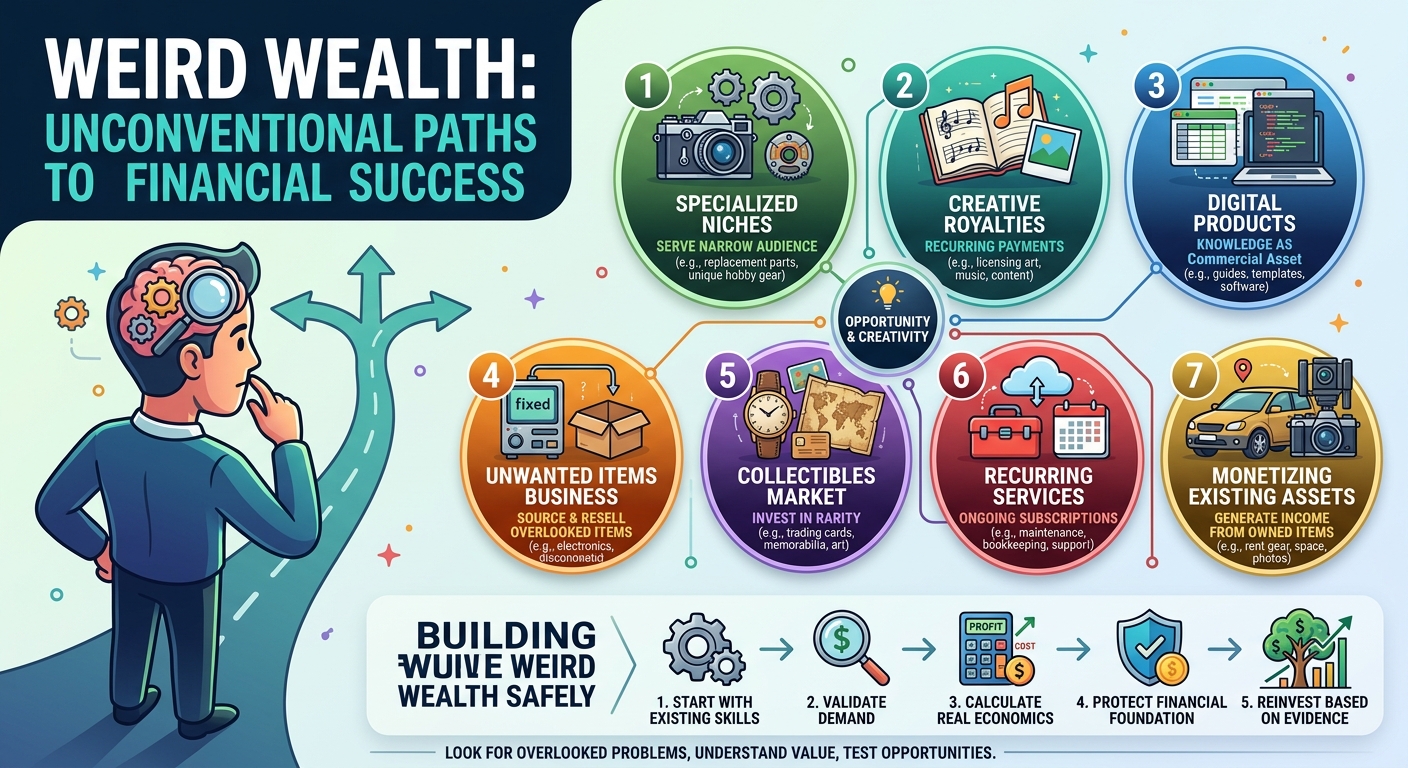
7 Unusual Ways People Can Build Wealth
Wealth can emerge from unexpected places when a person identifies a real need, develops something valuable, or manages an asset effectively. Here are seven unconventional approaches worth understanding.
1. Selling Products for Specialized Niches
Some businesses succeed by serving a narrow audience rather than trying to attract everyone.
Consider a seller specializing in replacement knobs for older kitchen appliances, accessories for vintage cameras, or organizers designed for a particular hobby. The potential customer base may be relatively small, but buyers can struggle to find suitable alternatives through general retailers.
A niche business can benefit from specialized product knowledge, focused marketing, and a reputation for reliability.
How to explore this opportunity:
- Identify a group with a specific unmet need.
- Research existing products and customer complaints.
- Estimate sourcing, shipping, marketing, and return costs.
- Test demand with a small inventory or preorder model where appropriate.
- Expand only after the numbers demonstrate that the business is viable.
A niche product is not automatically profitable. Demand, competition, supplier reliability, and profit margins still determine whether the idea makes financial sense.
2. Earning Royalties From Creative Work
Creative assets can sometimes generate income long after their initial production.
Examples include books, music, illustrations, photographs, educational materials, and licensed designs. Depending on the contract and distribution platform, a creator may receive royalties when another party sells, publishes, performs, or licenses the work.
Suppose an illustrator creates a set of original designs and licenses them for use on greeting cards. The illustrator may earn payments when the designs are used commercially without manufacturing every card personally.
This model can offer more flexibility than selling time alone, but success depends on demand, licensing terms, promotion, and the quality of the work.
Before licensing intellectual property, understand who owns the rights, how royalties are calculated, how long the agreement lasts, and whether the license is exclusive.
3. Turning Specialized Knowledge Into Digital Products
Knowledge can become a commercial asset when it solves a specific problem for a clearly defined audience.
Digital products include templates, spreadsheets, online courses, guides, design resources, and specialized software. A small business consultant, for example, might create a cash-flow spreadsheet that helps freelancers track invoices and recurring expenses.
Digital products may have relatively low reproduction costs once developed. However, creating the product is only part of the work. Customer acquisition, updates, technical support, refunds, and platform fees can affect profitability.
A practical starting point is to identify a task people repeatedly struggle with and build a simple resource that makes the task easier.
4. Building a Business Around Unwanted Items
One person’s unwanted item can sometimes be valuable to someone else.
Used electronics, discontinued components, vintage furniture, surplus materials, and repairable equipment may have resale potential. Businesses in this area can generate revenue by sourcing overlooked items, testing them, repairing them, and finding appropriate buyers.
For instance, someone with electronics repair skills might purchase a faulty device at a discount, replace a damaged component, and resell it after testing.
The calculation must include more than the purchase price. Repair materials, labor, storage, shipping, platform fees, and the possibility of unsold inventory all matter.
Start with products you understand, verify resale demand, and avoid spending heavily on items whose condition or authenticity is uncertain.
5. Investing in Collectibles
Collectibles are another source of unconventional wealth. Depending on demand and rarity, items such as trading cards, vintage watches, historical memorabilia, rare books, and certain works of art may appreciate over time.
However, collectibles differ from conventional investments in important ways. Their prices can be subjective, markets may be illiquid, and buyers may struggle to verify authenticity or estimate fair value.
An item advertised for thousands of dollars is not necessarily worth that amount. Actual completed sales, condition, provenance, transaction fees, and buyer demand provide better evidence.
Collectors should avoid treating every rare object as an investment. Buy only after researching the market, and never rely on speculative appreciation to meet essential financial goals.
6. Creating Recurring Revenue Through Useful Services
Recurring revenue can develop when customers pay regularly for a continuing service.
Examples include website maintenance, bookkeeping, subscription software, equipment servicing, and ongoing educational memberships. A web developer might offer small businesses a monthly package covering software updates, backups, security monitoring, and routine technical support.
This model can make revenue more predictable than constantly searching for one-time projects. It also creates ongoing obligations: customers expect consistent delivery, and cancellations can reduce income.
To develop a sustainable service business, define exactly what the monthly fee includes, set reasonable workload limits, and monitor customer retention alongside revenue.
7. Monetizing an Existing Asset
Sometimes, the opportunity to generate additional income comes from something a person already owns.
Depending on local laws, insurance, contracts, and demand, possible examples include renting suitable equipment, licensing photographs, leasing eligible commercial space, or renting out an unused parking space.
Consider someone who owns professional photography equipment but uses it only occasionally. Renting it to a trusted local professional could generate additional revenue, provided the arrangement addresses deposits, damage, insurance, and return conditions.
Calculate the net income after maintenance, platform charges, taxes, depreciation, and other expenses. An asset that generates cash is not necessarily producing a worthwhile profit.
Comparing Unconventional Wealth-Building Opportunities
Different approaches require different levels of capital, effort, and risk. The following table provides a qualitative comparison rather than a prediction of financial returns.
| Opportunity | Initial cost | Main challenge | Income potential |
|---|---|---|---|
| Niche product business | Low to high | Finding profitable demand | Depends on sales and margins |
| Creative royalties | Low to moderate | Building an audience or licensing demand | Can be recurring but unpredictable |
| Digital products | Low to moderate | Creating value and attracting buyers | Depends on demand and distribution |
| Reselling unusual items | Low to moderate | Sourcing and verifying products | Depends on margins and turnover |
| Collectibles | Varies widely | Valuation and resale liquidity | Uncertain and potentially negative |
| Recurring services | Low to moderate | Retaining customers | More predictable with stable contracts |
| Asset rental | Depends on existing assets | Maintenance and liability | Depends on utilization and costs |
The best choice depends on your resources and abilities. Someone with technical skills may find a specialized service easier to start than a collectible investment strategy, while a person with limited savings may prefer testing a digital product before purchasing inventory.
How to Build Weird Wealth Without Taking Unnecessary Risks
Unconventional wealth can be appealing, but unusual opportunities can also attract exaggerated promises. A sensible approach combines curiosity with financial discipline.
Step 1: Start With Your Existing Skills and Resources
List your professional skills, hobbies, useful equipment, industry knowledge, and existing assets. Consider which of these could solve a problem for another person.
You do not need a completely original invention. Improving an existing product, serving a neglected audience, or making a complicated process easier can be enough to establish a business opportunity.
Step 2: Validate Demand Before Investing Heavily
Research competitors, speak with potential customers, and look for evidence that people already spend money solving the problem.
Where practical, test the idea with a small batch, a limited service offering, or a basic prototype. Avoid taking on substantial debt before you understand whether customers are willing to pay.
Step 3: Calculate the Real Economics
Revenue is not the same as profit. A business selling a product for $50 might spend $20 on sourcing, $8 on shipping and fulfillment, $7 on platform and payment fees, and $5 on marketing.
That leaves $10 before overhead, taxes, returns, and the value of the owner’s time.
This simplified example illustrates why sales figures alone can make a business appear more successful than it really is.
Step 4: Protect Your Financial Foundation
Keep personal emergency savings separate from speculative business or investment money. Maintain appropriate records, understand tax obligations, and avoid risking funds needed for housing, healthcare, debt payments, or other essential expenses.
Be particularly cautious of opportunities that require large upfront payments, promise guaranteed returns, depend on recruiting other participants, or discourage independent research.
Step 5: Reinvest Based on Evidence
Once an opportunity produces genuine profit, consider reinvesting a portion into improvements that have a clear purpose.
That might mean purchasing better equipment, improving customer service, expanding a proven product range, or investing in marketing that can be measured.
Growth should follow evidence of demand rather than pressure to appear successful.
Common Myths About Weird Wealth
Myth 1: Unusual Ideas Always Make More Money
An unusual idea can attract attention, but attention does not guarantee paying customers. A familiar business with strong execution may outperform a creative idea that lacks demand.
Myth 2: Passive Income Requires No Work
Digital products, royalties, and rental assets can produce income without constant direct labor. Nevertheless, they may require maintenance, marketing, updates, customer service, and risk management.
Myth 3: Rare Items Always Increase in Value
Scarcity alone does not create demand. Collectibles can lose value because tastes change, new supply emerges, or buyers discover that an item is less desirable than expected.
Myth 4: Every Successful Entrepreneur Found a Secret Shortcut
Many unusual success stories involve years of learning, failed experiments, careful timing, and consistent work. The most visible result often hides the effort and risk behind it.
A better lesson is to search for overlooked value while remaining realistic about uncertainty.
Frequently Asked Questions
1. What does weird wealth mean?
Weird wealth refers to money or assets acquired through unusual or unconventional channels, such as niche businesses, creative royalties, specialized digital products, collectibles, or monetized assets. It is a descriptive phrase rather than a formal financial term.
2. What are some unusual ways people become wealthy?
People may build wealth through specialized product businesses, intellectual property, digital products, recurring services, resale markets, and carefully managed asset rentals. Results vary according to demand, costs, expertise, and execution.
3. Can unconventional income streams create lasting wealth?
Yes, some can contribute to lasting wealth when they generate sustainable profits and are managed responsibly. Long-term results generally depend on customer demand, financial discipline, diversification, and the ability to adapt when market conditions change.
4. What are the strangest businesses that make money?
Examples can include businesses selling replacement parts for discontinued products, niche repair services, specialized collectibles, unusual educational resources, or products designed for specific hobbies. Their success comes from serving real customers, not simply from being unusual.
5. How can someone build wealth outside a traditional career?
Start by identifying a marketable skill, an unmet customer need, or an asset that could generate income. Test the opportunity at a manageable scale, track actual profit, and reinvest carefully instead of relying on speculative promises.
Conclusion
Weird wealth shows that financial opportunities can exist beyond traditional salaries and conventional business models. Niche products, intellectual property, digital resources, specialized services, collectibles, and existing assets can all provide unconventional ways to generate income, although none guarantees financial success.
The most useful lesson is to look for overlooked problems, understand what customers value, and test opportunities before committing substantial money. Combine creativity with realistic financial calculations, careful risk management, and consistent execution.
