
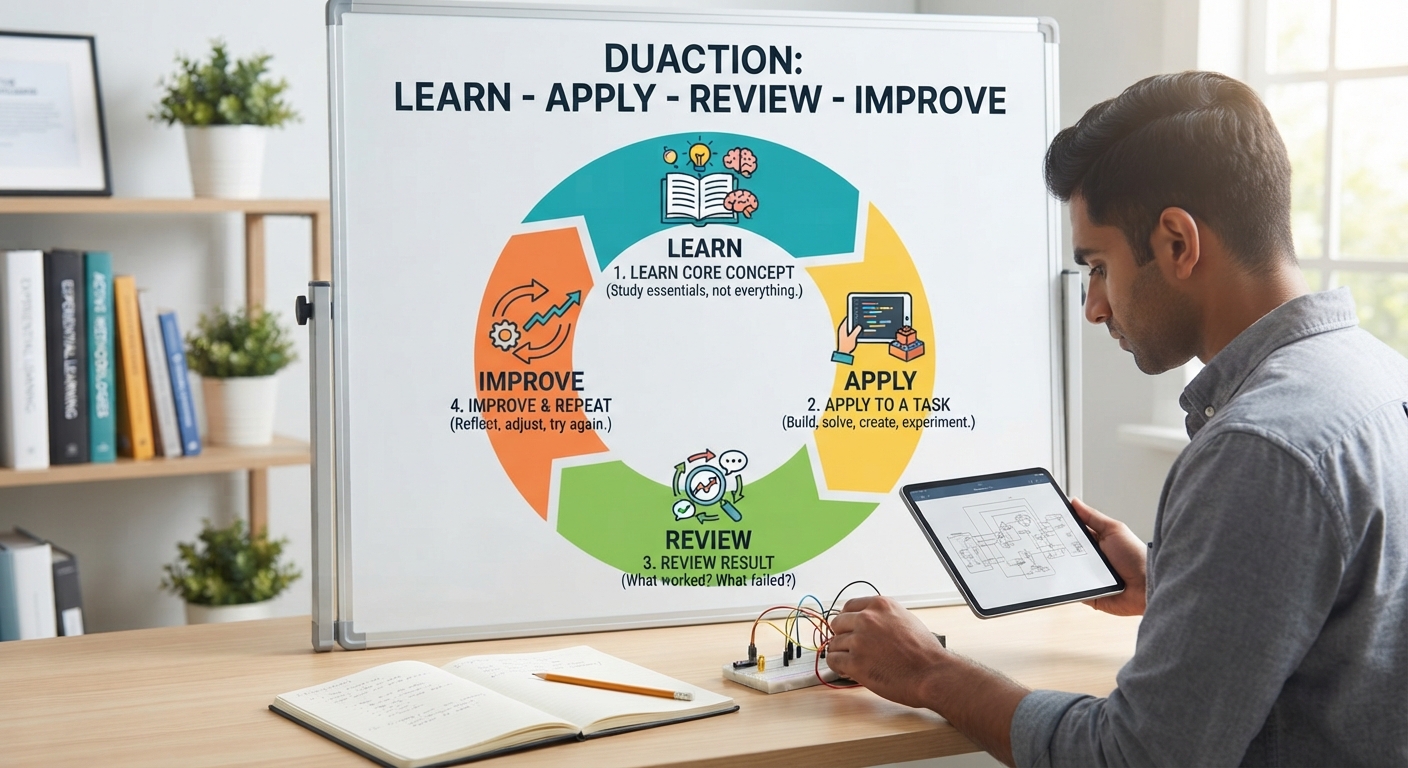
Duaction is an informal term currently used online to describe the combination of learning and practical action. In simple terms, it means taking something you learn and applying it through a task, project, experiment, or real-world situation rather than leaving the knowledge entirely theoretical. However, an important distinction is needed: Duaction does not currently have one universally accepted academic definition or standardized framework. Its underlying idea overlaps with established approaches such as active learning and experiential learning.
Quick Answer
Duaction generally means connecting learning with immediate practical action. A learner studies a concept, applies it, reviews the result, and uses that experience to improve. The term is relatively new and inconsistently defined online, so it is more accurate to treat it as an informal label than as a formally established educational theory. Established approaches such as experiential learning and active learning cover many of the same principles.
What Is Duaction?
The simplest way to understand duaction meaning is to think about two activities happening together:
- Learning: gaining information, concepts, or skills
- Action: using that knowledge in practice
Instead of spending weeks learning theory and only applying it at the end, a Duaction-style approach encourages learners to put new information into practice as soon as it makes sense.
For example, someone learning web development might first study HTML structure. Instead of only reading about tags, that learner could immediately create a basic webpage, test it in a browser, identify errors, and modify the code.
The practical activity reinforces the theoretical lesson.
This general idea is consistent with established experiential learning, which the University of Queensland describes as learning by doing and connecting theory and knowledge to real-world situations.
What Does the Word Duaction Mean?
Online explanations commonly describe Duaction as a combination of ideas represented by words such as “dual” and “action.”
The intended concept is usually straightforward:
Learn → Act → Review → Improve
However, the terminology should not be confused with an established academic discipline.
Current search results contain multiple explanations of Duaction, but they do not point to one universally recognized founder, institution, or standardized curriculum. One recent analysis specifically notes that competing websites give different definitions and that claims about a formal origin are difficult to verify.
That makes it safer to describe Duaction as an emerging or informal term for combining knowledge with action, rather than claiming that it is an officially recognized educational theory.
How Does Duaction Work?
A practical Duaction learning cycle can be organized into four stages.
1. Learn the Core Concept
Start with enough theory to understand what you are trying to accomplish.
You do not necessarily need to master the entire subject first. The goal is to gain the minimum knowledge needed to attempt a meaningful practical task.
For example, a person learning photography might study:
- Exposure
- Shutter speed
- Aperture
- ISO
- Composition
The next step is not another three hours of reading.
It is taking photographs.
2. Apply What You Learned
Use the new knowledge in an actual task.
This could involve:
- Building something
- Solving a problem
- Completing an experiment
- Creating a project
- Practicing a professional skill
- Running a simulation
- Working through a realistic scenario
This is where theoretical knowledge becomes practical knowledge.
3. Review the Result
After completing the task, examine what happened.
Ask:
- What worked?
- What failed?
- What did I misunderstand?
- What surprised me?
- What would I change next time?
Reflection is important because simply performing an activity does not automatically guarantee learning.
4. Improve and Repeat
Use what you discovered to make another attempt.
This creates a cycle rather than a one-time exercise:
Learn → Apply → Reflect → Improve → Apply Again
That cycle closely resembles the broader principles of experiential learning, where experience, reflection, analysis, and application are connected.
Duaction Examples in Real Life
The concept becomes easier to understand when applied to everyday situations.
Example 1: Learning Coding
A traditional approach might involve reading programming documentation for several days before writing a meaningful program.
A practical approach would be:
- Learn variables.
- Write a tiny program using variables.
- Run it.
- Fix errors.
- Learn another concept.
- Add that concept to the project.
The learner receives immediate feedback from the software.
Example 2: Learning Digital Marketing
Suppose someone is learning SEO.
Instead of studying SEO theory indefinitely, the learner could:
- Learn search intent.
- Choose a sample keyword.
- Analyze search results.
- Create an optimized outline.
- Publish or test the content.
- Review performance.
- Adjust the strategy.
The practical task reveals problems that may not appear while simply reading about SEO.
Example 3: Learning a Language
A student could learn vocabulary from a textbook and then immediately use those words by:
- Writing five sentences
- Having a short conversation
- Describing an object
- Translating a practical message
- Listening for the words in a real conversation
The action reinforces the information.
Example 4: Workplace Training
A new employee learning customer service could read company policies and then practice with simulated customer situations.
The trainer can provide feedback immediately.
This connects theoretical knowledge with a realistic workplace task.
Duaction vs. Traditional Learning
The difference is primarily about how quickly theory connects with practice.
| Learning approach | Main emphasis | Typical activity |
|---|---|---|
| Traditional theory-focused learning | Knowledge acquisition | Reading or lectures |
| Active learning | Learner participation | Problems, discussion, activities |
| Experiential learning | Learning through experience | Real-world tasks and reflection |
| Project-based learning | Extended practical work | Building a project |
| Duaction | Learning connected with action | Learn, apply, review, improve |
These categories can overlap.
In particular, active learning is a well-established educational approach. Carnegie Mellon University’s teaching guidance describes activities such as applying concepts, practice, and feedback as components of active learning.
Experiential learning is also an established concept with a substantial academic history. The University of Queensland describes it as connecting theory with real-world situations through experience and reflection.
Therefore, Duaction is best viewed as a label that overlaps with several existing approaches rather than automatically being treated as an entirely new educational science.
Is Duaction a Recognized Learning Method?
This is where accuracy matters.
There is currently no strong evidence that Duaction has the same formal academic status as established approaches such as experiential learning or active learning. Current online articles use the term in broadly similar ways, but definitions vary and there is no clearly established standardized framework associated with it.
That does not mean the underlying idea is unreasonable.
In fact, the broader principle of actively engaging with learning has substantial research behind it.
A major meta-analysis examined 225 studies comparing active learning with traditional lecture-based instruction in undergraduate STEM courses. It found that active learning increased examination performance by about 0.47 standard deviations and that failure rates were higher in traditional lecture settings.
The important distinction is that these findings support active learning, not Duaction as a separately validated framework.
What Are the Benefits of Duaction?
If Duaction is used as a practical description of learning combined with action, several potential advantages follow from the underlying educational practices.
Better Connection Between Theory and Practice
Reading about a skill and actually performing it are different experiences.
Practical work gives learners a context in which concepts become meaningful.
Faster Feedback
When learners act immediately, they discover mistakes sooner.
A student writing code, solving a mathematics problem, or practicing a presentation can see where understanding breaks down.
More Active Participation
Instead of simply receiving information, learners must make decisions.
This aligns with the broader evidence supporting active learning. Carnegie Mellon notes that active learning creates opportunities for applying concepts, practice, and feedback.
Development of Practical Skills
Some abilities cannot be fully developed through memorization.
Writing, coding, public speaking, laboratory work, design, negotiation, and many workplace skills require practice.
Opportunity for Reflection
The learn-and-apply cycle gives learners a reason to ask why something worked or failed.
That reflective element is central to established experiential learning approaches.
What Are the Limitations?
Duaction should not be treated as a magic formula.
Action Alone Is Not Enough
Doing something repeatedly does not guarantee that someone will understand it correctly.
Practical activities work better when learners receive appropriate instruction, feedback, and opportunities to reflect.
Some Subjects Need Strong Foundations
A learner cannot safely perform every task immediately.
Medicine, engineering, aviation, laboratory science, and other high-risk fields require foundational knowledge and appropriate supervision before practical application.
The Term Lacks Standardization
Different websites currently define Duaction differently.
That makes it difficult to compare “Duaction programs” in the same way that established educational frameworks can be compared.
Poorly Designed Activities Can Waste Time
A practical task should have a clear connection to the learning objective.
Doing an activity merely because it is interactive does not automatically make it educationally valuable.
How to Apply the Duaction Idea Yourself
You do not need a special app or expensive course to use the basic concept.
Try this five-step process:
Step 1: Choose One Skill
Avoid trying to learn everything at once.
Choose something specific, such as “write a Python function” rather than “learn programming.”
Step 2: Study for 15–30 Minutes
Learn the essential concept from a reliable resource.
Take only the notes you actually need.
Step 3: Create a Small Practical Task
Immediately use the concept.
If you are learning photography, take photographs.
If you are learning Excel, build a small spreadsheet.
If you are learning writing, draft a paragraph.
Step 4: Review Your Result
Compare the result against your goal.
Identify one or two specific weaknesses.
Step 5: Repeat With a Slightly Harder Task
Increase the difficulty gradually.
This produces a continuous feedback loop rather than a one-time lesson.
Duaction and Active Learning
There is considerable overlap between Duaction and active learning, but they should not be treated as exact synonyms.
Active learning is a recognized instructional approach in which learners actively participate through activities, discussion, problem-solving, and other forms of engagement rather than simply listening to a lecture.
Research support for active learning is substantial.
The widely cited Freeman et al. meta-analysis analyzed 225 studies and found improved assessment performance in active-learning environments compared with traditional lectures.
So, if your goal is to research evidence-based educational practice, active learning and experiential learning provide a stronger research foundation than treating Duaction as a standalone theory.
Duaction and Experiential Learning
The connection with experiential learning is even more direct.
The University of Queensland defines experiential learning as learning by doing and explains that it connects theory and knowledge with real-world situations. It also describes a cycle involving inquiry, reflection, analysis, and synthesis.
This is very close to the practical interpretation of Duaction found in recent online articles.
The difference is evidence and terminology.
Experiential learning has a recognized scholarly history. Duaction is a newer online label whose definition is still unsettled.
For an educator or researcher, that distinction matters.
Who Can Use the Duaction Approach?
The general learn-and-apply principle can be adapted to many situations.
Students
Use practice questions, projects, experiments, and simulations after learning new concepts.
Professionals
Apply newly learned workplace skills to controlled or low-risk tasks.
Entrepreneurs
Study a business concept and test it through a small experiment rather than relying exclusively on theory.
Teachers
Combine short explanations with exercises, discussions, demonstrations, and feedback.
Self-Directed Learners
Build small projects around almost any skill you want to develop.
The key is to match the practical task to the knowledge being learned.
Frequently Asked Questions
What does Duaction mean?
Duaction is an informal term commonly used online to describe combining learning with practical action. The basic idea is to learn a concept, apply it, review the outcome, and improve through another attempt.
Is Duaction a real learning method?
It is better described as an emerging or informal term than as a standardized academic learning theory. Current online sources use it to describe learning connected with practical action, but there is no clear universal definition or established framework.
Is Duaction the same as learning by doing?
The concepts are closely related. Current descriptions of Duaction emphasize applying knowledge through practical activities, while “learning by doing” is a broader and established description of experiential learning.
What are the benefits of Duaction?
The potential benefits come mainly from the underlying practices: active participation, practical application, feedback, reflection, and repeated practice. Research strongly supports active learning, although that evidence should not be presented as proof of a separately validated “Duaction” theory.
Does Duaction require technology?
No. The basic approach can be implemented with a notebook, classroom activity, practical assignment, workplace exercise, experiment, project, or real-world task. Technology can make practice easier in some subjects, but it is not essential.
Conclusion
Duaction is best understood as an informal term for connecting learning with practical action. Its central idea is simple: do not allow knowledge to remain purely theoretical when you can safely apply it, observe the result, reflect on what happened, and try again.
At the same time, it is important not to overstate what the evidence says. Duaction does not currently have the same established academic foundation as active learning or experiential learning. Those established approaches provide the stronger research base for anyone studying evidence-based education.
