
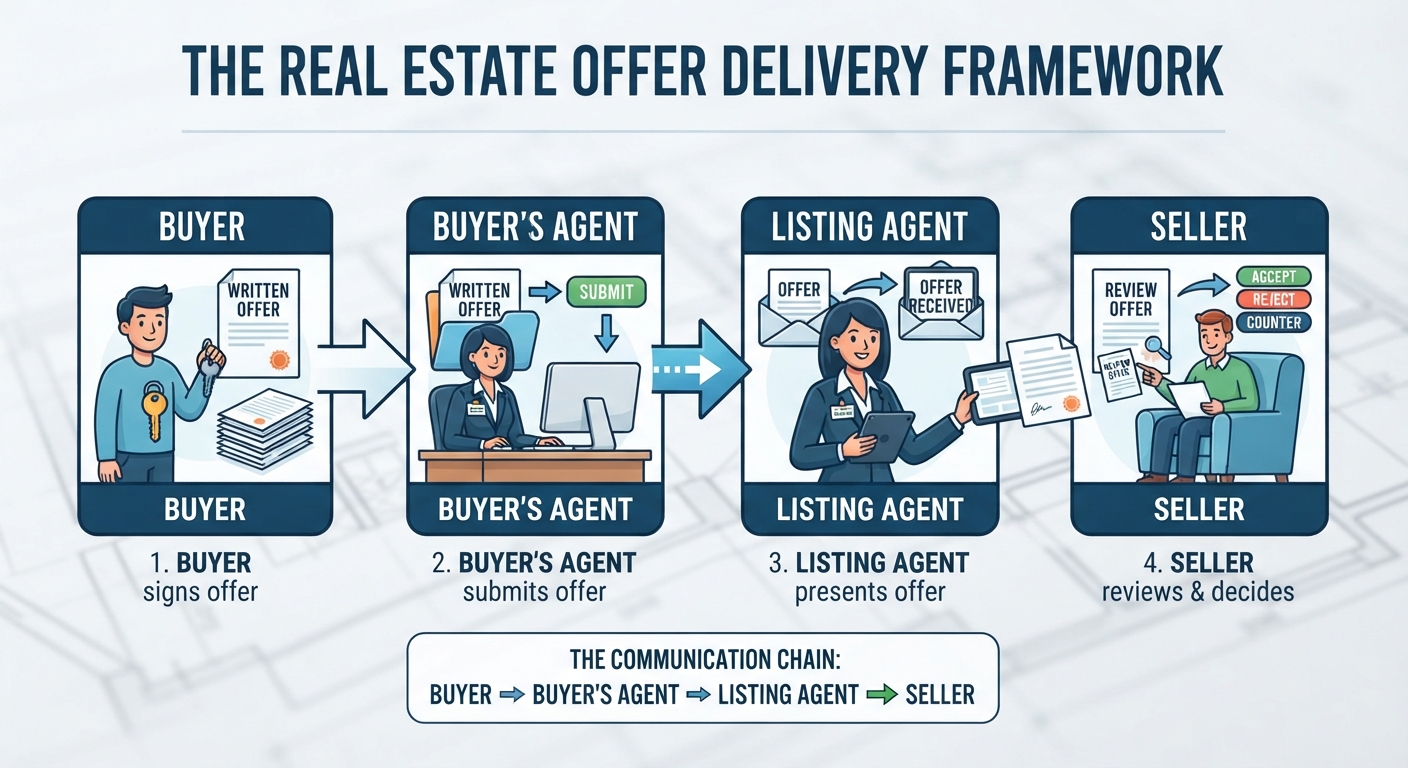
When you make an offer on a house, your buyer’s agent typically delivers the written offer to the seller’s listing agent, who then presents it to the seller. In a standard agent-represented transaction, the buyer usually does not send the purchase offer directly to the homeowner. Instead, the offer moves through a defined chain involving the buyer, buyer’s agent, listing agent, and seller. The exact process can vary by state law and the way the transaction is structured, particularly with FSBO properties or situations where one side is unrepresented.
Quick Answer
In a typical U.S. home purchase, the buyer’s agent submits the buyer’s written offer to the seller’s listing agent. The listing agent then presents the offer to the seller. If there is no buyer’s agent, the buyer may submit the offer through the appropriate channel themselves, often with legal assistance. For a For Sale By Owner (FSBO) property, the offer may go directly to the seller.
The distinction between delivering and presenting the offer is important.
The buyer’s agent normally handles the transmission from the buyer’s side. The listing agent normally receives the offer on the seller’s side and presents it to the seller.
What Is the “Who Delivers Your Offer to the Seller” Framework?
The phrase who delivers your offer to the seller framework is best understood as a simple way of mapping the offer-delivery process.
The basic chain looks like this:
Buyer → Buyer’s Agent → Listing Agent → Seller
Each person has a different role.
| Party | Typical role |
|---|---|
| Buyer | Chooses price and terms and signs the offer |
| Buyer’s agent | Helps prepare and submits the offer |
| Listing agent | Receives and presents the offer to the seller |
| Seller | Reviews the offer and decides how to respond |
| Lender | Provides financing documentation when applicable |
| Attorney | May review or facilitate documents depending on the transaction and jurisdiction |
This structure helps prevent confusion about who actually communicates the offer.
The person who writes or signs the offer is not necessarily the person who delivers it, and the person who receives it is not necessarily the person who makes the final decision.
Who Actually Delivers Your Offer to the Seller?
When You Have a Buyer’s Agent
In a conventional agent-represented transaction, your buyer’s agent is normally responsible for submitting your offer to the seller’s side.
The process usually looks like this:
- You decide how much you want to offer.
- Your buyer’s agent helps prepare the purchase offer.
- You review and sign the required documents.
- Your agent sends the offer package to the listing agent.
- The listing agent receives and reviews the submission.
- The listing agent presents the offer to the seller.
- The seller accepts, rejects, or counters the offer.
Real-estate sources describe this buyer-agent-to-listing-agent route as the standard process for represented transactions.
The offer is commonly transmitted electronically, although the exact delivery method depends on the brokerage, transaction platform, and local practice.
What Does the Listing Agent Do?
The listing agent represents the seller.
After receiving an offer from the buyer’s side, the listing agent generally reviews the submission for completeness and communicates it to the seller.
The seller’s representative may help the seller understand:
- Purchase price
- Financing terms
- Contingencies
- Earnest money
- Proposed closing date
- Inspection provisions
- Appraisal provisions
- Other contractual terms
The seller then decides whether to accept, reject, or negotiate.
The National Association of REALTORS®’ 2026 Code of Ethics states that REALTORS® should submit offers and counteroffers objectively and as quickly as possible. It also provides rules concerning the continued submission of offers to sellers unless the seller has waived that obligation in writing.
Buyer vs. Listing Agent: Who Does What?
Understanding the two agents makes the process much easier.
Buyer’s Agent
The buyer’s agent works with the purchaser.
Typical responsibilities may include:
- Helping evaluate the property
- Discussing offer terms
- Preparing or coordinating the purchase offer
- Communicating with the listing agent
- Submitting supporting documents
- Communicating counteroffers to the buyer
- Helping coordinate the transaction
The buyer’s agent does not make the final decision about what the buyer should accept. The buyer remains the decision-maker regarding their offer and contractual commitments.
Listing Agent
The listing agent works for the seller.
Typical responsibilities may include:
- Marketing the property
- Receiving offers
- Communicating offers to the seller
- Explaining transaction terms
- Communicating the seller’s response
- Negotiating within the authority given by the seller
- Coordinating with the buyer’s side
NAR describes the seller’s representative as the person hired to represent the seller’s interests under the agency relationship.
What Does a Real Estate Offer Usually Include?
An offer is more than a purchase price.
Depending on the transaction and jurisdiction, a purchase offer may address:
- Proposed purchase price
- Financing method
- Earnest-money deposit
- Inspection contingency
- Financing contingency
- Appraisal contingency
- Closing date
- Possession date
- Requested seller concessions
- Personal-property items
- Other contingencies and contractual terms
The Consumer Financial Protection Bureau notes that buyers can make their purchase offer contingent on financing and a satisfactory inspection, which can provide important protections if the buyer cannot obtain financing or a serious inspection problem emerges.
The exact contents of an offer vary considerably by state and transaction.
What Happens After Your Offer Is Delivered?
Submitting the offer is not the end of the process. It begins the seller’s response period.
Step 1: The Listing Side Receives the Offer
The listing agent receives the purchase offer and supporting documents.
The agent may check whether the package appears complete and then communicate the relevant information to the seller.
Step 2: The Seller Reviews the Terms
The seller can consider more than the headline purchase price.
For example, suppose two buyers make these offers:
Buyer A
- $500,000 price
- Financing contingency
- 30-day closing
- Inspection contingency
Buyer B
- $495,000 price
- Similar financing
- 20-day closing
- Different contingency structure
The seller may consider the entire package rather than simply choosing the highest dollar amount.
Step 3: The Seller Responds
A seller can generally respond by:
- Accepting the offer
- Rejecting the offer
- Making a counteroffer
- Asking questions or requesting clarification
A counteroffer changes the negotiation rather than simply accepting the original proposal.
Step 4: Negotiations Continue
The buyer may accept the counteroffer, reject it, or make another proposal.
The process can involve multiple rounds of negotiation.
Does the Seller’s Agent Have to Present the Offer?
This is an area where readers should avoid oversimplifying.
For REALTORS®, the current NAR Code of Ethics says listing brokers should submit offers and counteroffers objectively and as quickly as possible. Standard of Practice 1-7 also addresses the continued submission of offers and allows for a seller’s written waiver of that obligation.
However, NAR’s Code of Ethics is not the same thing as state law.
Real-estate agency duties, licensing requirements, brokerage policies, listing agreements, and other legal rules can differ by jurisdiction.
NAR itself advises real-estate professionals to consult state and local REALTOR® associations for applicable state and local requirements.
Therefore, if you have a dispute about whether an offer was properly presented, check the rules applicable to the property’s location and obtain appropriate legal advice.
What If You Don’t Have a Buyer’s Agent?
A buyer does not necessarily need a buyer’s agent to make an offer.
However, the process can be more complicated when you represent yourself.
In an unrepresented transaction, the buyer may submit the offer through the appropriate channel, which can include communicating with the listing agent.
Some buyers also use a real-estate attorney for document preparation or review, depending on the jurisdiction and transaction.
This distinction matters because the listing agent represents the seller, not the unrepresented buyer.
A buyer who does not have their own representative should therefore be careful about assuming that the seller’s agent is acting in the buyer’s interests.
What Happens With a For Sale By Owner Property?
A For Sale By Owner (FSBO) transaction removes the listing agent from the usual chain.
Instead of:
Buyer → Buyer’s Agent → Listing Agent → Seller
the process might look like:
Buyer → Seller
or:
Buyer → Buyer’s Agent → Seller
The exact process depends on who is involved and how the parties have agreed to communicate.
Realtor.com explains that when a seller is handling the property themselves, a buyer or buyer’s Realtor may deliver the offer directly to the seller.
What If One Agent Represents Both Sides?
Some transactions involve an agency arrangement in which the same agent or brokerage has relationships with both buyer and seller.
This can raise additional disclosure and consent requirements.
The 2026 NAR Code of Ethics states that REALTORS® may represent both sides of the same transaction only after full disclosure to, and informed consent from, both parties.
The legal rules governing dual agency or similar arrangements vary by state, so buyers and sellers should understand the applicable state requirements before proceeding.
How Is the Offer Usually Delivered?
The exact technology can vary.
Common methods include:
- Electronic transaction platforms
- Electronic signature systems
- Brokerage transaction-management systems
- In-person delivery in certain circumstances
- Other methods permitted by the parties and local practice
The important point is not necessarily whether the offer arrives by email or through a transaction platform.
What matters is that the correct parties receive the appropriate documents and that there is a reliable record of the submission.
A buyer should consider asking their agent to confirm that the offer was received.
NAR’s current Code of Ethics also provides a mechanism for a cooperating broker who submitted an offer to request written confirmation that the offer was submitted, or written notification that the seller waived presentation.
What Should Be Included With the Offer?
A complete offer package can be stronger operationally than an incomplete submission.
Depending on the transaction, it may include:
Purchase Agreement
This identifies the proposed price and major contractual terms.
Financing Documentation
A preapproval or prequalification letter can provide evidence that a buyer has discussed financing with a lender.
The CFPB explains that a preapproval or prequalification letter can give a seller more confidence that a buyer may be able to obtain financing, although it is not a guaranteed loan offer.
Proof of Funds
For cash purchases or certain transaction structures, proof of available funds may be requested.
Earnest-Money Information
The offer may specify the proposed earnest-money amount and applicable conditions.
Contingency Documents
Inspection, financing, appraisal, or other addenda may accompany the purchase agreement when applicable.
The precise requirements depend on the contract and jurisdiction.
Common Mistakes When Delivering an Offer
Mistake 1: Sending an Incomplete Package
Missing signatures or required documents can create delays.
Before submission, verify that all requested documents have been completed.
Mistake 2: Assuming the Listing Agent Represents You
The listing agent’s primary agency relationship is with the seller.
If you are an unrepresented buyer, clarify who represents whom before discussing sensitive negotiation matters.
Mistake 3: Focusing Only on Price
A purchase offer contains more than a number.
Closing timing, contingencies, financing, deposits, and other terms can materially affect the transaction.
Mistake 4: Ignoring Deadlines
Offers commonly contain expiration or response deadlines.
Know exactly when your offer expires and how changes or counteroffers affect those deadlines.
Mistake 5: Assuming Rules Are Identical Everywhere
Real-estate law is jurisdiction-specific.
A procedure that is normal in one state may work differently elsewhere.
A Simple Offer-Delivery Checklist
Before submitting your offer, review this checklist:
Buyer
- Confirm the desired purchase price
- Review financing
- Decide on contingencies
- Confirm proposed dates
- Sign required documents
Buyer’s Agent
- Check the offer package
- Attach relevant supporting documents
- Submit the offer to the appropriate party
- Confirm receipt
- Track the response deadline
Listing Agent
- Receive the submission
- Communicate the offer to the seller as required
- Explain relevant terms
- Communicate the seller’s response
Seller
- Review price and terms
- Consider financing and contingencies
- Accept, reject, or counter
- Provide instructions to the listing agent
This simple structure makes the real estate offer process much easier to follow.
Why the Delivery Chain Matters
Offer delivery is not merely administrative.
It creates a communication chain between people who have different roles and responsibilities.
For buyers, a clear process can help establish:
- Proof that the offer was submitted
- A record of important deadlines
- Clear communication
- Fewer misunderstandings
- Better coordination between agents and other professionals
For sellers, the process helps ensure that offers reach the decision-maker through the appropriate representative.
The exact legal obligations depend on the jurisdiction and representation structure, but the underlying principle is straightforward: everyone should know who is sending the offer, who is receiving it, and who has authority to respond.
Frequently Asked Questions
Who delivers your offer to the seller?
In a typical U.S. residential transaction with both parties represented, the buyer’s agent submits the written offer to the seller’s listing agent, who then presents it to the seller.
Does the buyer’s agent send the offer directly to the seller?
Usually, the buyer’s agent sends the offer to the listing agent rather than directly to the seller. The listing agent then communicates the offer to the seller. The process can differ for FSBO transactions or other representation arrangements.
Can a buyer submit an offer without an agent?
Yes, buyers can participate without a buyer’s agent, but the appropriate process varies. An unrepresented buyer may communicate the offer through the listing side or use an attorney or other appropriate professional depending on the transaction and jurisdiction.
What happens after the seller receives an offer?
The seller reviews the proposed price and contractual terms and can generally accept, reject, or counter the offer. The response and negotiation process depends on the transaction documents, deadlines, and applicable law.
Can a seller refuse to consider an offer?
The answer depends on the seller’s instructions, agency relationship, applicable law, and professional rules. For REALTORS®, the 2026 Code of Ethics contains specific requirements concerning the submission of offers, including circumstances involving a seller’s written waiver.
Conclusion
The who delivers your offer to the seller framework is easiest to understand as a communication chain:
Buyer → Buyer’s Agent → Listing Agent → Seller
In the typical represented transaction, the buyer’s agent submits the offer, while the listing agent communicates it to the seller. When a buyer is unrepresented, when a property is FSBO, or when an unusual agency arrangement exists, the path can change.
The most important thing is to understand who represents each party, what documents are being submitted, when the offer was received, and which local rules apply.
